FREE SHIPPING & FREE RETURNS | 1st CLASS USPS for orders $100+ in the US.
Incorporating Beads and Gemstones in Your Knitting Projects - The Bead Traders

Incorporating Beads and Gemstones in Your Knitting Projects

Knitting with beads and gemstones is a great way to add some additional sparkle to your projects. Whether you are making a shawl, a pair of gloves or just about anything else, you can add beads or gemstones for a more unique finish. There are a few different techniques for knitting with beads, but in this post, we will be showing you how to add beads as you go using a crochet hook. Let’s get started!

Gather Your Supplies

The exact supplies you need varies depending on the specific project you are working on. Check your pattern for details. In general, however, you will need knitting needles in the appropriate size, a 1mm crochet hook, yarn and beads. You may also want to consider using graph paper to help you visualize exactly where your beads will be placed in your work.

Get Started on Your Project

For this technique, you do not need to pre-string any beads. Instead, start working on your project and knit as far as you need to go prior to placing your beads. When you are ready to start adding beads, make sure you have your beads and a crochet hook that is small enough to hold the beads you are using. Carefully place your first bead on the hook.

Catch the Knit Stitch and Place the Bead

When you reach the stitch on which you want to place your bead, use the crochet hook to grab the stitch. If the yarn is slippery, hold it between your fingers to avoid dropping it. Next, remove the stitch from the knitting needle and slide it onto the crochet hook. Pull the bead over the stitch so that it surrounds your yarn. Finally, use your crochet hook to slide the stitch onto the right knitting needle.

Continue Working

Women's hands knitting

Now that you have placed your first bead, you can continue working on your project. Continue knitting and adding beads as necessary. When you are on the wrong side of the work, simply knit the stitch with a bead on it the same way you would work a regular stitch.

It’s that simple! In a few easy steps, you can add beads and gemstones to your work even if you are relatively new to knitting.

Choosing Beads for Your Knitting Projects

Beads and gemstones come in an endless array of materials, sizes and shapes. This can make choosing the right ones for your projects challenging. If you are working with lace weight or fingering yarn, tiny seed beads are a popular choice. For worsted weight and bulky yarns, you, of course, need larger beads. Glass beads and natural gemstone beads are usually preferred over plastic ones.

colorful stone beads

When shopping for beads for your next knitting project, be mindful of the weight of your yarn. Pay close attention to how thick the yarn is and look for beads with holes that are large enough to work. Keep in mind that if you use the technique listed above, the yarn will need to fit through the hole when doubled over since you are slipping each bead onto a stitch. If you want to use tiny seed beads, you may need to use a different technique, such as pre-stringing your beads.

Sewing Beads onto Your Finished Projects

Sewing beads onto your finished projects is another option. This method works well when you are using beads with holes that are too tiny to be strung onto your yarn. This is also a good option when you are working with larger beads or gemstone beads that wouldn’t work so well if knitted into your project. Whether you want to add sparkle with crystal quartz beads or you are thinking about using freshwater pearls, sewing them on works well for virtually any project.

For small beads, you can use a regular sewing needle and matching thread. For larger beads, you will need to use a tapestry needle and yarn. Insert your threaded needle into the wrong side of your finished project where you want to place the bead and pull it through to the right side. Leave several inches and thread your bead onto the strand. Insert your needle into the right side of your fabric and pull through to the wrong side. Pull several inches through and then cut. Tie the loose ends together and then weave into your project on the wrong side.

Whether you knit your beads into your work or you sew them on after you are finished, using beads is a great way to create beautiful pieces that shine!


Read more
Beading 101: How to Get Started Making Jewelry - The Bead Traders

Beading 101: How to Get Started Making Jewelry

There are many benefits to learning how to make jewelry. First and foremost, it is fun! Making jewelry is a hobby that allows you to express your creativity in an enjoyable and relaxing way.

Learning how to make jewelry is also practical, and you can learn to make beautiful, handmade, and custom pieces for family, friends, and perhaps eventually, potential customers. Inspiration is everywhere!

Beginning jewelers may not know exactly how to start making jewelry and in general, the art of jewelry-making, whether it be for business or pleasure. Here are a few tips and tricks that will help you translate your interest in jewelry-making into a rewarding and lasting endeavor.

INVEST IN THE RIGHT JEWELRY-MAKING TOOLS

down divider

Creating high-quality pieces with low-quality tools is difficult for even the most advanced jewelry makers.

The basic, must-have tools that any beginner should have to get started creating their very own beautiful jewelry and beading projects include:

  • Wire Cutters
  • Round-Nose Pliers
  • Flat-Nose Pliers
  • Crimping Pliers
  • A Ruler/Tape Measure
  • A Bead Organizer
  • Adhesive, such as the E-6000
woman using pliers learning how to make jewelry

While you may be tempted to scrounge for tools that “sort of” fit the bill in your household toolbox at first, investing in the proper tools will help you turn out better pieces from the get-go.

The cost of high-quality tools more than pays for itself. Purchasing specialty tools may seem like an investment at first, but well-made and designed tools outlast their cheaper counterparts, and you will find that you will have to replace high-quality tools much less frequently.

…AND IN THE RIGHT MATERIALS!

down divider

Not only is having the right beading materials necessary but picking out beads is also one of the most fun parts of getting into jewelry-making and developing your unique style! Some necessary beading materials for beginners include:

  • A Variety of Glass Beads
  • Beading Cord
  • Memory Wire
  • A Beading Needle
  • Earwires
  • Clasps and toggles
  • Headpins and Eyepins
  • Crimp Beads
  • Beading Wire
  • Beading Thread
  • Fire-Polished Beads

While pre-composed bead kits can be convenient, they are not always the most cost-effective choice unless you like and plan to use all the beads included in the kit.

how to make jewelry with beads closeup of diy necklace

Gemstone beads, glass beads, opal beads, and crystal beads offer a more high-end finish for pieces than their cheaper Lucite and plastic options and will fetch a higher price if you plan to sell your creations. Better beads are also longer lasting. Also, invest in a container with compartments to store your beads so they can be sorted by size, bead, and color, making them easy to find.   

START SMALL

down divider

You may have been inspired to learn how to make jewelry with beads by the creative and intricate pieces of other jewelry artists. However, as a beginner, it is best to start small.

There are plenty of free project tutorials available online geared toward those who are just getting started in the art of jewelry-making.

By starting small, you will slowly build up your skill set and abilities, and you will find yourself capable of making the beautiful pieces that inspired your interest in jewelry.

LEARN THE LINGO

down divider

Before making any purchases, it is best to do your research and become familiar with jewelry-making lingo.

Knowing the different purposes of various materials will give you a better idea of what it is that you need for a project and save you the time and expense of returning unnecessary items.

Being familiar with the vernacular will also help you advertise your pieces if you plan to sell them.

For example, various necklace lengths have certain names:

Collar

12”-13”

Choker

14”-16”

Princess

17”-19”

Matinee

20”-24”

Opera

25”-34”

Rope

35” and up


necklace length names graphic

BECOME FAMILIAR WITH INDUSTRY STANDARDS

down divider

Before putting all your time into creating a unique piece of jewelry, it is important to become familiar with standards within the industry. This includes the standard lengths for necklaces, bracelets, chokers and anklets.

Women            

Men

Kids

Baby

Necklace

17”-35+”

20”

12”-14”

10”-12”

Choker

14”-16”

18”

8”-10”

--

Bracelet

7”-7 ½”

8”-11”

5 ½”-6 ½”

3 ½”-5”

Anklet

9”-9 ½”

11”-14”

7”-8”

4”-4 ½”


industry standard lengths table

With these standard lengths in mind, remember that custom measurements are always best for commissioned pieces.

Aside from the various lengths, it also pays to be versed in the various birthstones and their corresponding birth months and semiprecious alternatives.

Month

Precious Stone

Semiprecious Stone

January

Garnet

Rose quartz

February

Amethyst

Onyx

March

Aquamarine

Red jasper

April

Diamond

Rock crystal

May

Emerald

Chrysoprase

June

Moonstone

Pearl

July

Ruby

Carnelian

August

Peridot

Aventurine

September

Sapphire

Lapis lazuli

October

Tourmaline

Opal

November

Citrine

Topaz

December

Zircon

Turquoise


birth month precious and semiprecious stones

Making birthstone jewelry is an easy and fun way to personalize a gift and it guarantees an audience for your creations.

FIND YOUR JEWELRY STYLE

down divider

The vast range of jewelry-making styles can make even the idea of getting started seem daunting.

Should you start by learning how to make jewelry with beads? Or is the idea of incorporating leather into pieces more tempting? Are you a fan of the simplicity of metal-worked jewelry, or do you find yourself drawn to the vibrancy of glass beads?

The answer comes down to your style and preference. What style of jewelry do you find yourself wearing time and time again? Looking through your jewelry box is a good place to start. Find which pieces are your favorites and try to discern a common theme among them.

For example, if you like the boldness of statement pieces that involve daring bead choices and cutting-edge color, you will most likely have trouble trying to mimic the minimalist style of metal stamping.

Moreover, why choose to make jewelry you would not want to wear? It is best to choose the style you most enjoy first and dedicate yourself to mastering the ins and outs of that distinct style of jewelry-making before trying to take on something you are less familiar with.  

After developing one skill, you can always move on to another as your tastes develop and use what you have learned to help you accomplish a new skill set.

CREATE YOUR OWN WORKSPACE

down divider

Anyone who has worked from home knows the frustration of not having their own space for taking care of their daily work.

Not only does working in an open area lead to distractions, but it also leads to disorganization. Having your supplies all over the house rather than in one place leads to wasted time and lost supplies.

Set aside a room, corner, or even just a desk for yourself and dedicate it to your craft. Keep your space organized with boxes, Tupperware, and labels. You can find creative storage ideas online on sites like Pinterest that will suit any needs.

Once you have found an organizational method and developed a crafting schedule, stick to it! Keeping organized will ensure your crafting hobby remains enjoyable and relaxing and doesn’t become another unneeded stressor in your life.

JOIN A JEWELRY-MAKING CLASS

down divider

how to start making jewelry

If you have specific jewelry-making skills in mind that you would like to learn, consider looking into beginner courses for those skills.

Many craft stores and online sites offer fun and interesting courses in general beginner topics as well as in more specific skills, such as metalwork, clay metal, soldering, beading courses, and resin work.

Classes are also an excellent way to become familiar with basic beginner skills, such as making wire loops and working with jump rings.

As in any industry, networking is essential and classes are an excellent opportunity to meet other jewelry enthusiasts and learn from the best in the industry! There is nothing like learning a skill first-hand from someone with a wealth of knowledge on the topic and building up a network within your hobby will keep you interested and expand your social circle with like-minded people.

With a little dedication, you may be the expert that the beginners are turning to one day.

PERUSE THE WEB FOR INSPIRATION

down divider

The internet is an invaluable tool for jewelry makers, whether you are a professional or just starting. You can use the internet to find supplies online, research new techniques and troubleshoot, search for inspiration and DIYs, market your products, and view market trends. Our bead blog is full of helpful information as well.

These websites are particularly conducive for jewelry makers of any level.

  • Designinspiration
  • Designinspiration is a social media search engine that is an excellent source of inspiration for anyone in the creative field and an organizational tool for many jewelry makers.

    You can use Designinspiration to search for ideas and inspiration for any kind of design. The save feature can be used to make a digital vision board and save images of jewelry and other artwork that inform and inspire your brand.

    DIY tutorials and information blogs are also collected and concentrated on the website, and it is an excellent way to instantly refine your search and find only the best and most useful information.

    You can also follow the boards and pins of other jewelry makers and brands you admire and see what it is they are focusing on. This helps you keep ahead of the curve and trends in the jewelry industry.

    After starting to develop a line of jewelry, you can also use Designinspiration to post photos and advertise information about what you are creating, which makes it an invaluable and free marketing tool.

  • The Bead Traders
  • TheBeadTraders.com is an online bead supply source that offers a vast selection of high-quality beads and beading supplies. Their hand-selected inventory of gemstones, pearls, and metal beads is available at the click of a button and from the convenience of your own home.

    making beaded jewelry

    Not only does the site stock an impressive collection of rare gemstones and everyday beads, but they also cater to all of your findings, chain by the foot, and finishing needs. Their superior customer service makes for hassle-free transactions and a pleasant buying experience, and their blog is an excellent resource for information about working with specific gemstones and findings. Many of the blogs include DIY projects geared toward beginners and inspire advanced jewelry makers. 

  • YouTube
  • It is likely you already use this video-sharing tool to view videos, listen to music, or watch television. However, it also serves as a useful tool for creativity due to the millions of free DIYs and tutorials uploaded to the site annually.

    YouTube is particularly helpful for beginning jewelry makers or jewelry makers on a budget who are looking to learn new skills before investing in the cost of in-person courses.

    However, it is best to remember that quantity does not equal quality. The wealth of information that is available on YouTube is a double-edged sword, and the quality of videos range from very high to extremely low.

    Look for jewelry artists who have well-developed channels and who are dedicated to their craft. Once you have found a YouTuber whose content you like and trust, you can subscribe to their feed and never miss an episode

  • Jewelry Making at DotDash.com
  • Dotdash.com, like its predecessor About.com, is a collection site that is split between six different topics, each of which is dedicated to teaching users how to accomplish various tasks and crafts.

    Thoughtco is the portion of the site that is dedicated to publishing how-tos and articles from experts about any form of crafting, including jewelry-making. It has a collection of tutorials and e-courses for individuals of any experience level.

    For more experienced learners, you can even sign up for a direct email newsletter for certain, more directed techniques and skill learning.

    person using pliers learning how to start making jewelry

    DON'T LIMIT YOURSELF

    down divider

    Remember that when it comes to your jewelry-making hobby, there are no limits! Do not limit yourself to one skill set or one style of jewelry if you become interested in another.

    Trying new things with your work should not be intimidating. It should be fun! If you stay curious and do not shy away from experimenting with new techniques, sizes, colors, styles, and viewing new arrivals, you will be amazed at what you can create.

    And who knows–your new jewelry-making hobby might lead to the lifelong practice of creating beautiful jewelry pieces for yourself and others. Don’t delay, learn how to start making jewelry today!

    Read more
    The Complete Guide to Jewelry Clasps and Toggles - The Bead Traders

    The Complete Guide to Jewelry Clasps and Toggles

    Jewelry-making involves a lot of fun and creative thinking, from the color to the style to the size of the piece you are creating. One aspect of jewelry-making that usually falls to the wayside is the type of closure or clasps you will use to finish your piece. Although they are often overlooked, the findings you decide to use will ultimately impact the longevity and wearability of your piece.

    Jewelry findings are the components, except beads, used in beaded jewelry-making to finish a piece of jewelry. It is good to become familiar with the various types of clasps and toggles and their uses whether you are new to jewelry-making or simply looking to expand your jewelry-making expertise.

    Interlocking or C Clasps

    Interlocking clasps, also called C clasps, are fastening mechanisms that interlock with one another without utilizing a closing mechanism.

    The interlocking clasp consists of a c-shaped piece and a corresponding identical piece or jump rings. The clasp is circular with a small opening on the side, much like the shape of the letter C. The c-shaped piece then hooks or locks into the corresponding piece.

    Interlocking clasps make a good closure for heavy necklaces because the weight of the necklace helps to keep the fastening in place.

    Button Snap Clasps

    Button snap clasps have only recently become more popular in jewelry-making. As the name suggests, a button snap clasp is a fastening that utilizes a button cap with a stud that snaps into a button socket.

    Button snaps are another clasp that affords extreme ease of use. They can be effortlessly fastened with one or two hands and are appropriate closures for any jewelry type. Button clasps can also be quite decorative and add a fun and unexpected element to an otherwise simple piece of jewelry.

    However, it is best to keep in mind that the button clasp mechanism can pull apart under a certain amount of force. Button clasps should not be used for expensive pieces that contain precious stones.

    Barrel Clasps

    Barrel clasps are another popular closure for both fine jewelry pieces and everyday wear because they are simple to use and offer a reliable hold.

    These clasps get their name from their shape rather than their function. They consist of two metal pieces, one of which has a protruding screw end that screws into the corresponding piece, which has a threaded socket.

    The biggest drawback of these pieces is that they require two hands to use. Because of this, it is a poor choice for bracelets. They are made to blend with the chain and not distract from the beads or jewels themselves.

    Toggle Clasps

    gold bracelet

    Toggle clasps are beautiful, elegant, and easy to use closure pieces that are extremely versatile. They vary considerably in style, size and finish, but they are usually designed to stand out on a piece and add to its overall look.

    Toggle clasps are composed of an open piece that is most often a circle but may also consist of a centerless triangle, square or other shape and a corresponding bar piece. The clasp is fastened by manipulating the t-shaped bar piece through the center of the corresponding shape. The bar is then turned to lock in place.

    Toggle clasps can be used for various jewelry types and are easier to manipulate with one hand than other clasp variations. However, as with other hook-based clasps, they work best when used as a fastener for heavier jewelry. This is because heavier pieces pull on the clasp, which makes for a more secure fastening.

    Toggle clasps are usually the most decorative clasps available online, and they let you run away with your creativity. Some are even designed to be worn as a visible part of a necklace or bracelet.

    Magnetic Clasps

    small metal parts

    A magnetic clasp relies on a magnetic bond as a fastener. The two corresponding ends both contain magnets. When placed near one another, the ends snap together with little to no effort on the part of the wearer.

    Because of their ease of use, magnetic clasps are an excellent choice for designers who are developing pieces for older individuals who can no longer manipulate small or fine fastenings. They are also a good choice for children’s jewelry, as most children do not have the motor skills necessary to work more complex fixtures.

    However, it is important to keep in mind that a magnetic clasp is only as strong as the magnetic pull of its magnets and they may not be the best choice for fine jewelry pieces.

    Like toggle clasps, magnetic clasps vary in size, shape, finish and style and it is easy to find magnetic clasps online to match almost any piece.

    Whatever your jewelry-making style or preference, there is a wide variety of choices of jewelry findings available online so you can create one-of-a-kind pieces. 

    Read more
    January Birthstone: Garnet Beads - The Bead Traders

    January Birthstone: Garnet Beads

    Beautiful garnet stones are the official birthstone for January. Although the garnet is most often associated with the deep pomegranate red of Pyrope Garnet, they are mined in a variety of colors, from reds and oranges to vibrant greens.

    Despite this, the word garnet is rooted in the Latin term “granatum,” which means seed, and the 14th Century Middle English word “gernet,” which translates to “dark red.” It is easy to see how the name was derived, as typical garnet stones are very similar to the deep red seeds of the pomegranate fruit in both color and shape.

    However, the term garnet does not refer to a single mineral, but a group of them. Garnet minerals all exhibit similar crystal forms and physical composition but vary in their actual chemical composition. This is why they are available in such a vast range of colors.

    History of the Garnet

    Garnet stones have a long history of use as decorative and ceremonial stones by Egyptians, and the earliest found pieces date to 3100 B.C. Early Egyptians used the precious stone to adorn their jewelry, homes and tombs.

    Like most gemstones, the garnet stone was historically considered to possess various powers. The red color gave rise to its association with blood and battle, and it represented the notion of victory in dangerous pursuits.

    Because of its association with protection and victory, garnets were used as talismans by Roman crusaders and warriors in ancient times. Those who used these talismans believed the power of the garnet stone would keep them safe from death and injury.

    It was also associated with medicinal purposes because of its deep red color. Garnets were placed near or on injuries throughout Medieval times because many believed the stone promoted the healing process and stopped bleeding.

    Other traits of the stone included protection for travelers, protection against poison and even the ability to rid the wearer of bad dreams.

    Because of the mystical powers they hold, garnets have been a popular gift across various cultures for many centuries.

    Origin and Mining

    Garnet minerals are found and mined all over the world, and different species of the stone are found in the various locations across the globe. The most recent species discovered in the 1990s is the beautiful blue Madagascar garnet.

    Other species can be found in Brazil, Wyoming, Russia, Greece, Sri Lanka, India and Central Europe.

    The deep red Czech Bohemian garnet, large deposits of which were discovered in the 16th century in Czechoslovakia, remains one of the most common origins of the stone.

    Because it varies so drastically in color, garnet stones are often confused with other gem types. The stone itself must be identified by other means, including its occurrence in metamorphic rock, its 6.5-7.5 hardness on the Mohs Scale and its crystal structure.

    Garnets also vary significantly in terms of size. The smallest garnets found are tiny slivers of the gem, and the largest can grow to the size of an apple.

    Types and Colors

    uvarovite chromium bearing garnet group

    There are more than 20 varieties of garnet species, but the six main species are pyrope, almandite, spessartite, grossularite, andradite and uvarovite. Because of this variation in species, there is also a significant variation in the colors of garnet stones.

    Garnet stones occur naturally in every color and are even found in colorless varieties and collections that change their color according to the lighting. Some color-change garnets can appear blue in natural lighting and change to burgundy when exposed to incandescent light.

    The most commonly occurring color is a range of reds, from russet reds to deep, nearly purple burgundies. Red garnets usually belong to the pyrope and almandite species. The rarest garnets are those found in the green and blue shades that are typical of the tsavorite and demantoid garnet varieties.

    Symbolism and Energy

    The symbolism of garnets today is still largely based on mythology. In Greek mythology, Hades gifted pomegranate seeds to Persephone as a token of safety before she traveled, and garnets now symbolize a safe return for travelers and a speedy return for those traveling from home.

    Because of their typical red color, garnets are also associated with love and sensuality. It is said to incite passion and love but also aid in obtaining emotional balance for the wearer.

    Finally, the garnet stone is also linked to heart and blood health. Used as a healing stone, it is believed to be anti-inflammatory and stop hemorrhaging.

    Wearing Garnets

    garnet bracelet

    Garnet stones are distinctly strong and resistant to tarnishing or breakage, which, coupled with their striking colors, make them a popular choice for use in jewelry. Because of their already opulent coloring, garnets are typically paired with simple sterling silver settings.

    The garnet gemstone makes an excellent gift for anyone with a January birthday, and its association with protection and love makes it the perfect token of goodwill going into the new year. Garnet is also the official stone that is gifted for second anniversaries.

    Garnet stones have been prized for centuries for their beautiful coloring and mystical powers. No matter how you choose to use or wear them, garnets make an excellent addition to your crystal or jewelry collection in January and all year long.

    Read more
    The History of Natural Turquoise Beads - The Bead Traders

    The History of Natural Turquoise Beads

    Turquoise calls to mind the very distinct blue- and green-colored gem that is synonymous with the Southwest. It has a rich history, and its use in jewelry and art spans centuries as well as the entire globe.

    How did turquoise get its name?

    While its origin is contested, you can most likely thank the French for the name “turquoise.” Some etymologies imply that turquoise is named for the country of Turkey, or “Turquoise,” as it was once commonly believed that turquoise originated in this part of the world. A further possibility is a more literal translation, as the French term “pierre turquin” translates to “dark blue stone.”

    Regardless of its origin, the beautiful blue-green color of turquoise beads is recognizable all over the world.

    How does turquoise form?

    Turquoise forms in areas with dry soil comprised of large copper deposits. When water containing minerals like copper and aluminum leaks through the rocks, a chemical reaction takes place and veins form in the rock surface. This results in the development of chunks of natural turquoise. The chemical reaction is what lends a veined look to turquoise.

    Turquoise is then mined, and you may have even come across some pieces that contain traces of the “host rock.” The host rock mixes with the turquoise and this why you might see some black or brown patches in real turquoise.

    Where does turquoise come from?

    Several distinct places around the globe are renowned for their production of turquoise.

    It is mined in China, Chile, Egypt, Iran, Mexico and the southwestern United States.

    Chinese turquoise

    turquoise isolated

    Chinese turquoise has been mined in various parts of China for more than 2,000 years. The colors of Chinese turquoise vary, from light to deep blues and dark greens. Chinese turquoise often contains dark veins of host rock.

    Dark blue Chinese turquoise with delicate black spider-webbing is highly sought-after and a favorite of collectors.

    Persian/Iranian turquoise

    Iranian turquoise is known to come from the northeastern city of Neyshabur. The turquoise mined from this region has long been considered of exceptional quality and is prized for its color, which ranges from sky blue to dark blue.

    Not only was turquoise from this part of the world used for jewelry, but it was also used in architecture. Turquoise tiles were used to cover the domes of mosques as it was a symbol of heaven on earth.

    Egyptian turquoise

    Turquoise in Egypt was once considered a holy stone that would bring its holder good luck. In fact, in Egypt, turquoise even has its own goddess, Hathor, who was known as the “Lady of Turquoise,” and she was considered the protector of the region where turquoise was found in Egypt.

    The turquoise found in this part of the world is unique in that its host rock, or “matrix,” is reddish to gold in color. This unique look may be the reason turquoise has maintained popularity in Egypt.

    Turquoise used in trading

    While gold, silk, tea and spices are renowned for their historical use by traders, turquoise was traded in a similar manner. The most famous turquoise traders were the Anasazi people, who established trade routes in the western part of North America and Mesoamerica.

    The Anasazis began mining turquoise as early as 200 B.C. and believed the gem had great powers. Artisans used it to create mosaic pieces. These would then be traded to civilizations in modern-day Mexico. Artworks made by Anasazi artisans containing turquoise have even been found in Chichen Itza, a former Mayan city on the Yucatan Peninsula.

    silver and turquoise jewelry

    Native American use of turquoise beads

    Turquoise beads have a special significance in many Native American cultures. Some tribes see turquoise as a symbol of strength and skill, while other tribes saw it as a symbol of invincibility. Still others associated turquoise with spirituality, healing and good fortune.

    According to one legend, turquoise is the “fallen sky stone” that is hidden in Mother Earth. Another legend states that when it rained, the Native Americans would be so happy they would cry tears of joy, which would mix with the rain and become the “sky stone” known as turquoise.

    Today, turquoise remains one of the most popular stones of Native American jewelry. The Navajo people, in particular, believe that turquoise is a symbol of happiness, luck and health, and they often craft it into gorgeous beads, heishi necklaces and other jewelry.

    Final Thoughts

    With its stunning colors and historical use around the globe, turquoise is still a popular gemstone. Whether you love it for its color or its perceived powers, turquoise beads make for an excellent addition to your jewelry collection.

    Read more
    How to Use Lava Stone Beads to Make Diffuser Jewelry - The Bead Traders

    How to Use Lava Stone Beads to Make Diffuser Jewelry

    Lava stone beads are an extremely popular trend in jewelry right now due to their unique appearance and properties. The tone itself is typically rough, dark and chunky, yet extremely lightweight due to its porousness. These qualities make them the perfect stone for use in essential oil diffuser jewelry.

    Where does lava stone come from?

    Lava stone beads are shaped pieces of volcanic lava stone. Magma, a superheated mixture of gases and minerals, boils until it eventually erupts, spreading as lava across the surface of the earth. Lava cools relatively quickly once it hits the earth’s surface, forming into the volcanic, or igneous, rock known as basalt.

    Because the lava cools so quickly, gas bubbles remain trapped in the rock, leaving holes and pockets throughout. This porosity is what makes lava stones very light in relation to their size and convenient for use in diffusing essential oils.

    Metaphysical properties of lava

    Associated with the root chakra and the Taurus and Cancer zodiac signs, lava stone is believed to be grounding. It is said to enhance an individual’s connection with the earth, and to promote strength and courage. In the past, lava stone was often carried by soldiers to help them stay calm in the heat of battle.

    Lava is renowned for its calming properties, and it is typically used in massage therapy for relieving stress and anxiety. Because it is formed from a molten rock that cools into new rock, lava is a symbol of rebirth, and carrying lava stone helps release draining, negative emotions.

    Combining the natural metaphysical properties of lava stone beads with essential oils in diffuser jewelry can give your essential oil therapy a serious boost. 

    What are the benefits of diffusing different essential oils?

    There are two common methods for using essential oils. The first of these is a topical application or applying the oil directly to the skin, usually with a diluting base oil such as almond or coconut oil. The second method of use is by diffusion, which is accomplished through a heated water or wax source, or by tapping a few drops of oil onto linens.

    lava stone bead necklace

    Portable diffusion is becoming an increasingly popular means of taking the calming, uplifting effect of your essential oil therapy to-go, and essential oil diffuser jewelry is a fantastic way to reap the benefits of essential oils discreetly.

    Lava stone beads are an ideal stone to use for diffuser jewelry due to their abundance of pores, which essential oils can easily seep into. One oil application to a lava stone can even last for several days.

    To enhance the lava’s calming and grounding effects, try pairing it with an oil that has similar qualities. Lavender oil is popular for both its scent and its ability to reduce anxiety and promote sleep. Another excellent option for increasing energy levels is lemon oil. Ylang ylang is an anxiety-busting oil that helps to regulate blood pressure.

    You may also want to try oils that do not offer the same effect as lava, but a complementary one. Eucalyptus oil, for example, helps relax blood vessels, which aids in circulation and amplifies the calming effects of the lava stone. Rosemary oil improves focus while the lava works to relax you.   

    Many essential oil companies offer proprietary blends for addressing specific needs, such as reducing stress and anxiety or increasing focus. The variety of oils available also makes it easy to mix-and-match your very own special blend for your own purposes.

    Ways to incorporate lava stone into your jewelry

    There are various ways to integrate lava stone beads into your jewelry. It is recommended the jewelry is designed so the lava beads are worn in contact with the skin. Necklaces, bracelets and earrings all work well for this purpose.

    A lava stone diffuser necklace can be designed to suit your style. Placing a single stone in an ornate setting denotes elegance or string several unique beads together for a bolder look, like the gorgeous black lava necklace with a gold butterfly pictured above. For a simpler style, a single round lava stone on a length of leather cord or an elegant chain makes a striking statement piece.

    lava stone bead bracelet on rocks

    For those who prefer bracelets to necklaces, consider making a lava stone diffuser bracelet. A set of small, rounded lava stones strung along the wrist is classic yet simple, while larger stones lend a trendier appearance. Lava bead bracelets make a lovely gift when paired with a favorite essential oil. 

    Lava stone beads are also an excellent choice for making big, bold drop earrings or try placing smaller lava stone beads on a ring for a funky and functional way to diffuse your essential oils.

    Read more
    Create Jewelry with Timeless Style with Opal Beads - The Bead Traders

    Create Jewelry with Timeless Style with Opal Beads

    The beautiful, diverse and ancient opal gemstone makes gorgeous jewelry that is perfect for all types of occasions. Ranked second only to the emerald by the Romans, it was included among the noble gems and was considered lucky.  

    About Opals

    Opals are the birthstone for October. The opal gets its name from the Greek word “opallios,” meaning alter, due to its changing colors.  

    Opals are amorphous, so they do not have a defined structure but come in a variety of colors, shapes and sizes.

    This gemstone is found on just about every continent. The term “opalescence” refers to the milky-white or pearly luster that the majority of opals exhibit.

    Rare opals display flashes of color when rotated. The flashes are known as the play of color.

    Formation

    Geologists believe this gemstone takes close to five million years to form. It is made from silica, which was very common in prehistoric Australia, for example, between 20 and 30 million years ago. Opal forms when the silica solidifies between crevices and rocks.

    While scientists are still unsure of the precise mechanism by which opals form, some believe that the process begins when silica washes down into the rock crevices during heavy rains. They theorize that after the water evaporates, the silica gel that remains solidifies over millions of years until the opal forms. Opals have a water content of between 5 and 20 percent, so their composition seems to support this hypothesis.

    Opal takes 5 million years to form

    The color of precious opals is the result of impurities in the silica. Different minerals or chemicals in the silica create the range of colors opals often display.

    The opalescent property of these gemstones results from the way the silica crystals are distributed in the material. Individual silica molecules are spherical. When they fuse, small spaces form between the spheres. These spaces allow light to diffract, causing different shapes and colors to emerge.

    Australia has dominated opal production since the late 19th century, accounting for more than 90 percent of the total world output.

    Opal Crazing

    Some opals are affected by crazing, a condition that causes the gemstones to form internal cracks. Crazing is inconsistent and can be unpredictable, sometimes occurring at random. It usually happens when the gemstone is removed from damp conditions and dries very quickly or when it is suddenly exposed to bright light.

    Crazing can also happen when the opal experiences excessive vibration, such as during cutting and polishing. Crazing also seems to be related to the place of origin of the opal, as opals from some mines are more prone to crazing than opals from other areas.

    To prevent crazing, jewelers should observe a long drying process before working on the stone. Good drying methods can take anywhere from a few months to several years to achieve results that can keep the gemstone suitably stable for use in jewelry.

    History of the Opal

    Natural opal stone

    The first opal dates to 4000 B.C. Louis Leaky, a renowned anthropologist, found opals in a cave in Kenya during an excavation.


    The rich and powerful of ancient Rome were the first to see the value of opals. The ancient Romans loved the colorful gemstone. One of the historical figures who is said to have been fond of the gemstone is Mark Antony, Cleopatra’s lover. Legend has it he offered one-third of his land for an opal to gift to the Egyptian queen.

    In the late 18th and early 19th century, the opal was branded as bad luck and associated with death. Queen Victoria opposed this superstition, and she gifted her five daughters with the opal, making it fashionable in Royal circles.    

    Good Luck or Bad Luck?

    One look at the patterned interior of a spectacular opal can reveal why it has been at the heart of countless myths throughout history. Legends of its mystical power, stories about it in literature and competition for possession of this gemstone still exist today.  

    The ancient Romans thought it was a symbol of hope, similar to the rainbow. Pliny, the ancient Roman author, stated opals were the most beautiful of all stones because of their array of colors.

    Ancient Greeks thought the milky stone would give the bearer the ability to prophesize, while ancient Arabians believed opals rained down from heaven.

    During the Middle Ages, the opal was highly valued and often placed with lucky talismans. It was believed if you wrapped an opal in a bay leaf, you’d gain the powers of invisibility, and many thought it improved eyesight. Blonde women wore the gem to keep their hair color from fading.  

    The opal became associated with bad luck during the era of the Black Plague. A rumor spread that someone who died from the Black Plague was wearing an opal that turned a dull color once they passed.  

    The stone continued to be associated with death when the Spanish King Alfonso XII gave one to his wife, Mercedes, who died shortly after. The King then gave it to his grandmother, his sister and his sister-in-law — all of whom also died. Then he wore the opal ring himself and died. Despite the unfortunate coincidence, the royal family died from cholera, not a cursed opal.  

    Sir Walter Scott wrote the novel “Anne of Geierstein” in 1829, which adversely influenced the market for opals. The main character, Lady Hermione, wears an opal in her hair that changes color with her moods. When holy water touches the opal, it becomes discolored, so she is thought to be a demon and dies.

    Opals returned to favor 20 years later because of the discovery of black opals, which Queen Victoria favored and were considered lucky.

    Diamond traders started spreading the rumor that it is bad luck to wear this gemstone if it is not your birthstone. These traders did not want to lose business when opals became popular during the 19th and 20th centuries, so they spread the rumor to dissuade people from buying them.

    Today, however, with better technology and a deeper understanding of the facts, many people see beyond the idea of bad luck and good luck to what opals really are: beautiful gemstones with a unique opalescence that other gems cannot match. This renewed interest in opals is making it one of the most popular gemstones on the market.

    Trends in Opal Jewelry

    Opal jewelry is having a major moment in the jewelry world. The Louis Vuitton: Acte V collection featured a captivating opal stone, and designer Wing Yau’s work is synonymous with the gemstone. Opals are typically set in constellation-like earrings, rings and necklaces, but the latest trend has been toward delicate, intricate and sophisticated pieces like those worn by Emma Watson and Cate Blanchett.   

    Vintage Wedding/Engagement Rings

    Opal wedding and engagement rings are popular, especially with the millennial generation. It is currently one of the top-performing engagement ring trends, especially when set in rose gold.

    The gemstone’s unique beauty makes it an ideal choice for the unconventional bride. It captivates the eye with flashes of color that make the iridescent stone mesmerizing.

    This October birthstone has a magical glow and has been steeped in mystery since the Middle Ages. Opals are said to symbolize fidelity, and they are a truly one-of-a-kind ring since they are non-replicable.

    They are softer than most gemstones with a Mohs rating of 5.5- 6.0, so care must be taken when wearing and caring for your ring.  

    Statement Jewelry

    Giorgio Armani, Stella McCartney and several other big-name designers made earrings the essential jewelry accessory of their fall and winter collections.   

    Silver earrings with white opal stone

    Opals are part of the collection that has given way to striking pieces that work as a strong and extravagant look. They still look delicate when intricately added to drop earrings or swinging hoops.

    Mismatched earrings are still on trend, as are solo earrings. Geometric designs and glittering gemstones were all the rage at the shows by major fashion houses. If you are a fan of this mystical stone, looking fashionable choices and making a statement isn’t difficult.   

    Body Jewelry

    Celebrities and Instagrammers are obsessed with opal body jewelry. Sporting the opaque gemstone with a kaleidoscope of colors embedded into it is like wearing a rainbow.  

    The mysterious opal also allows body jewelry designers a way to add natural elements to their collection.  

    Types of Opals

    Regardless of the type, opals have been considered talismans of good luck for centuries and are linked with connotations of magical properties. They can be categorized by three main types based on their color and varieties. The types are common, fire and precious opals.  

    Common opals are typically found in vintage jewelry and are lighter or white in color. They do not exhibit a play of color. Common opals are found in many locations around the world.

    Fire opals can be found in Mexico and Ethiopia and are a vivid reddish-brown to deep orange. They may or may not exhibit the play of color.

    Precious opals are dark and black and are mostly found in Australia, though they are also mined in Canada, Honduras, Poland, Peru, Guatemala, Ethiopia, Zambia, Indonesia and Mexico. The precious opal flashes iridescent colors when it is viewed from different angles.

    Some of the most sought-after opals are:  

    Black or Dark Opal

    Black opals are mined in New South Wales, Australia. They are characterized by a black body tone that causes a bright quality of color the lighter shades simply cannot match. They are thought to bring good luck.

    Pink Opal

    Pink

    Pink opals are relatively rare, found only in the Andes mountains of Peru or in western Australia.

    Pink opals are associated with thoughtfulness and enhancing love. It is considered to be the “stone of hope,” and many think it helps people fulfill or enhance their potential.

    This opal is said to have healing properties and can help promote a feeling of calmness. Since the stone retains some water inside it, this opal has water energy, which can help balance your aura. Pink opals are also thought to help relieve stress and keep nightmares away.

    Other names for pink opals include angel’s stone and queen’s stone because it is valued as both stunning and feminine.

    Dendritic Opal

    Dendritic Opal

    Dendritic is used to describe the beautiful tree-like inclusions found in some opals. The marks appear due to the presence of silicates or manganese oxides. This type of opal is mined in New Mexico.  

    Associated with hope and life, the dendritic opal is said to change your luck for the better.

    If you want to sense the energy near you and try to understand people better, dendritic opals can help by enhancing your mental power.

    Dendritic opal beads come in all shapes and sizes and are widely available and affordable.


    Blue

    The blue opal is mined in Peru. Although it is a common opal and does not have a play of color, it is still very desirable. It is associated with spiritual healing and helps the one who wears it feel peaceful, making it an excellent choice for those experiencing a lot of stress.

    Communication is easier when wearing a blue opal. Insight is another property of this gemstone, as understanding what is going on with the people around you can help enable better communication.

    Some believe that this opal raises one’s self-confidence. The gemstone is believed to give the wearer courage to do what needs to be done and not worry about the future.

    Making Opal Jewelry

    Opal jewelry is making a resurgence in popularity. Design your own family keepsake or create a one-of-a-kind piece as a gift. A homemade opal pendant is the perfect craft to start with whether you are a novice or have been making jewelry for years.  

    The opal is a beautiful stone for jewelry, but since it is softer than most other gemstones, it is best suited for pieces that rarely encounter impacts. When used in a ring, the best designs have a bezel to protect the stone.

    Double-Stretch Opal Bracelet

    Pink opal beads

    This striking double-stretch bracelet can be made using your favorite opal. Elastic bracelets are versatile and easy to wear. Choose a good quality elastic cord that is complementary to the opal beads you are using. Although a common option, clear elastic is more noticeable with dark colored beads.  


    Vintage Haskell-Style Beaded Pendant

    Another pendant but a different look! Miriam Haskell’s elaborate beaded jewelry designs come to life in this exquisite vintage pendant. Opals are the ideal gemstone for this iconic look that uses the Fireline caging technique.  


    Beaded Bobby Pins

    Invented in 1899 in Paris by Luis Marcus, bobby pins are our favorite accessory. Their name was coined after the Bob hairstyle because they were used to keep bobbed hair in place. Embellish them with opals for a whimsical, retro look. They are perfect for adding some glam to your everyday ensemble.  


    A Beautiful Stone Throughout the Ages

    A single opal can flash every color of the spectrum with hypnotic intensity. The opal is one of the most popular gemstones on the market and can command prices that rival diamonds, emeralds and rubies.


    Read more
    Make Your Own Rosary with a Rosary Chain and Other Jewelry-Making Accessories - The Bead Traders

    Make Your Own Rosary with a Rosary Chain and Other Jewelry-Making Accessories

    If you were raised in the Roman Catholic Church, chances are you already own a rosary. Even if you are not Catholic, a rosary can make a wonderful gift for anyone celebrating a baptism, first Holy Communion, confirmation, or the marriage of a friend or relative who is Catholic. Before we can show you how to make a beaded rosary, it is vital to understand what a rosary is and the various components that make it up. Let’s explore.

    What is a Rosary?

    A rosary is a length of beads and other attachments strung on a cord or metal chain. In the Catholic religious practice, a rosary is a devotional tool used to focus one’s attention on prayer and encourage meditation on the life of Jesus Christ.

    learn how to make a rosary with beads and chain

    What Are the Components of a Rosary

    Rosary beads can be made from a wide variety of materials, including wood, glass, agate, quartz, opal and countless other gemstones. Rosary beads are typically — but not always — round or oval and may be smooth or faceted.

    A rosary consists of more than just a string of beads, however. The “findings” are all the other components of the rosary except the beads. These include a crucifix, a center or medallion, the chain itself, and all the other connecting metal pieces, like wire, eye pins, and jump rings.

    The metal chain can be made of gold, silver, or any suitable combination of precious or non-precious metals. The various pieces of a rosary should complement one another in color, pattern, shape, and size. Other than that, you are limited only by your imagination in designing your rosary.

    What Tools and Supplies Do I Need?

    Rosaries can be made using individual beads, chains, and other findings. Alternatively, you can purchase lengths of pre-beaded gold rosary chain by the foot, for example, which will significantly simplify your project. However, you will still need some other tools and supplies to make your rosary.

    At TheBeadTraders.com, we offer a vast selection of beads and jewelry supplies online. Here is what you’ll need to make your own rosary:

    • 2 pairs of pliers: flat-nose pliers to hold and manipulate the piece you are working on and “rosary pliers,” which are a handy combination of round-nose pliers used to create loops and side-cutting pliers used to cut wire and chain. Round-nose pliers and a separate wire cutter can be substituted for rosary pliers.
    • 53 small (6-8 mm) beads, 10 for each of five groups of beads for the “Hail Mary” prayer, plus three additional “Hail Mary” beads. Each group of 10 beads is called a “decade.”
    • 6 separator beads to say the “Our Father” prayer, which can be the same size or larger than the decadal beads
    • 14 short pieces of chain (3-4 links each) to connect the decadal beads with the separator beads and other rosary components
    • Wire or eye pins
    • 1 medallion or “center” (often depicting Christ, Mary, a saint, or a biblical event)
    • 1 cross or crucifix
    • 4 jump rings: three small jump rings to connect the medallion and one larger jump ring to connect the crucifix
      person making a rosary with pliers

      How Many Beads To Make a Rosary?

      Based on the materials listed above, a typical roman catholic rosary contains 59 beads. Make sure to purchase enough when starting your rosary-creation process.

      How To Make a Rosary Yourself

      Learning how to make a rosary with string and beads can seem daunting at first, but it is simpler than you may think. Read below to learn how to make a rosary step by step and share your creations with us!

      1. Create the five decades of beads

      First, cut 53 same-length pieces of wire, one for each decadal bead. Each piece of wire should be long enough to create a loop on each end. For each piece of wire, make a loop at one end using your rosary or round-nose pliers. Insert the straight end of the wire through the hole in the bead, and then make another loop identical to that on the other side.

      Rather than cutting individual pieces of wire, an easier method is to use eye pins, which are already cut to size and have a loop on one end. Simply insert the straight end of the eye pin through the bead and then form a loop on its end, as described above.

      Once you have constructed all 53 bead segments, join them together, using your flat-nose pliers to open, connect and close the loops at either end of each bead. Repeat this process 50 times, joining 10 beads together into each of five segments or decades. Join the remaining decadal beads into a single group of three beads. This group of beads will be used in the last step to connect the crucifix to the rest of the rosary.

      1. Connect the separator beads to the decades

      For the six separator beads, cut six same-length pieces of wire as described above. As in the previous step, each piece of wire should be long enough to create identical loops on both ends of each bead. The length of wire will depend on the size of the separator beads chosen. Eye pins may be substituted for the wire.

      Cut 14 segments of chain (3-4 links each) to connect all parts of the rosary. Twist open the loops on the ends of each separator bead, add a chain segment on each end of the bead, and close the loop. Connect the free end of each chain segment to one end of a decadal segment made in the previous step. Continue this process until all five decadal segments are connected to the separator beads. This step will use four of the six separator beads and 10 of the 14 pieces of chain.

      1. Connect the medallion and crucifix

      The medallion or “center” has two holes on either side of its upper end and one hole on its lower end. Connect one small jump ring to each of the three holes in the medallion. Add a segment of chain to each of the upper two jump rings and connect the free end of each chain segment to opposite ends of the single strand of beads assembled in the previous two steps.  You will now have a complete circle of rosary beads connected by the medallion.

      The crucifix is connected to the medallion and circle of beads with another short string of beads. First, attach one of the four remaining segments of the chain to the small jump ring already connected to the bottom end of the medallion. Connect the free end of this chain segment to one separator bead, followed by a second chain segment, then the three-bead segment created in step 1, followed by a third chain segment, another separator bead, and finally the fourth (and last remaining) chain segment.

      Attach the free end of the last chain segment to the hole at the top of the crucifix using the large jump ring. Make sure the face of the crucifix and the front of the medallion are oriented in the same direction.

      Making your own rosary can be a spiritual and rewarding experience, and they make a unique and heartfelt religious gift

      If you are interested in learning how to make a rosary with string only, feel free to search online through many of the wonderful tutorials. 

      How To Make a Rosary Bracelet

      Creating a bracelet from extra materials is a great idea. We suggest you learn how to make a rosary bracelet after you have mastered the skill and meaning of the rosary necklace. Come back soon for more information on how to make a rosary bracelet.


      FAQ’s

      How many beads are on a Rosary?

      The Rosary chain is composed of a string of beads, each representing one prayer in the Rosary. This custom of reciting the Rosary began in the twelfth century and quickly spread through Europe thanks to its popularity as a way to turn simple prayers into a devotion. 

      Where to buy Rosary Beads?

      Rosary Beads are everywhere, from traditional sites to Bead Traders' online stores. It is essential to find Rosary Beads of quality material and ensure you are getting a Rosary Chain that will stand the test of time. A Rosary Chain often includes a cross or crucifix charm and is used to aid prayer and meditation. 

      What Are The Rosary Beads Meaning?

      Rosary beads serve a particular purpose to those who use them. They are used as a visual aid to help keep track of prayers, known as the Rosary. Many people don't know that Rosary chains have been around since the 6th century and have held religious significance for just as long. Rosaries are an essential part of many religions, including Christian and Catholic faiths, in which it is believed reciting them brings a strong connection between the speaker and God. 

      Get What You Need at The Bead Traders!

      Now that you are armed with the knowledge of how to make a rosary with string and beads, it is time to put everything into practice. Start using your creativity to create a one-of-a-kind rosary that will bring peace and joy to its users. For wholesale bead pricing, visit our wholesale page. If you have any questions, feel free to contact us. We look forward to seeing what you make.

      Shop the Bead Traders today for expert-curated, high-quality gemstone beads, crystal beads, opal beads, and more.

      Read more
      Create Eye-catching Jewelry with Labradorite Beads - The Bead Traders

      Create Eye-catching Jewelry with Labradorite Beads

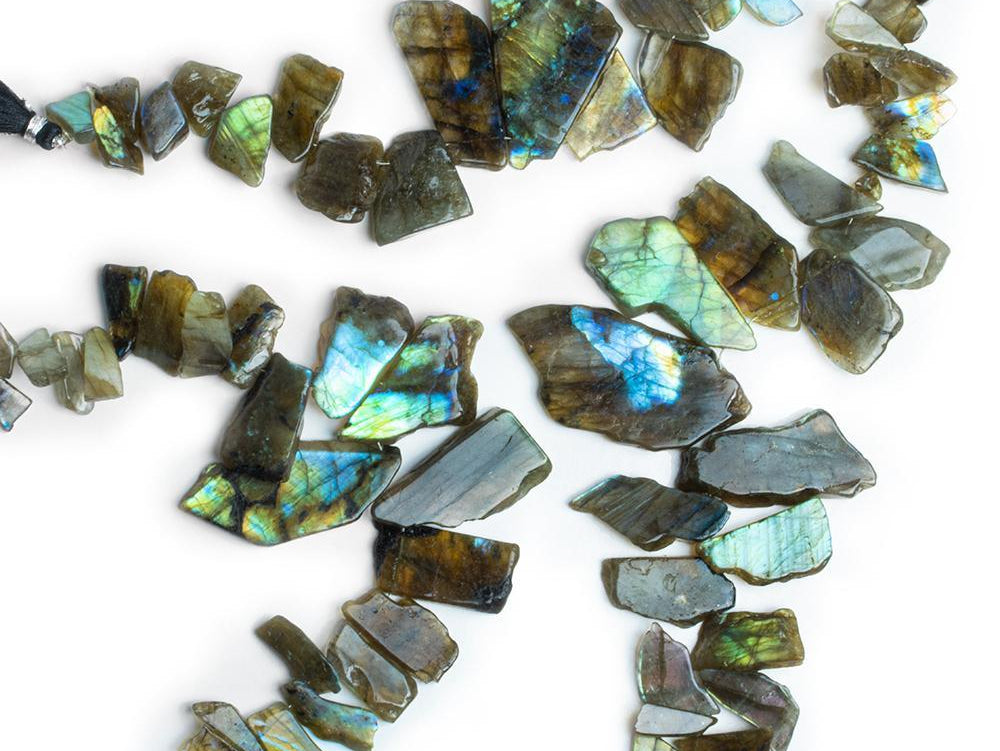
      Labradorite is a popular gemstone that produces a stunning play of colors — known as labradorescence — which moves as the stone is rotated. This dazzling optical phenomenon is due to the formations of intergrowths within its structure that create a shimmery, ethereal effect.

      Origin

      A Moravian missionary discovered the gemstone in 1770 on the Canadian Isle of Paul in Labrador.

      Spectrolite is the trade name for the high-quality labradorite mined in Finland that produces intense color flashes, known as the schiller effect.

      Madagascar and Russia produce a large amount of gray and black labradorite that has labradorescence, while transparent labradorite is mined in India. The gemstone is also mined in the United States, Mexico, South America and Norway.

      The state of Oregon produces yellow, orange, red, blue, green and clear labradorite that does not have any labradorescence. Copper inclusions can create an aventurescence flash. These gemstones are called Oregon Sunstones and are very popular because they can be carved, faceted and polished to create stunning jewelry. In 1987, the Oregon state legislature designated it as the state’s official gemstone.

      closeup labradorite mineral

      Characteristics

      Labradorite is part of the plagioclase series of minerals that are made up of feldspars. This gemstone contains between 50 and 70 percent anorthite and is widely used in the glass and ceramics industries.

      Although it appears as a dirty gray color in the rough, cut stones have a metallic luster and an iridescent sheen.

      The structure has tiny, repeating layers of twinning inclusions that are composed of black magnetite or ilmenite and exhibit some fracturing. This structural interference creates the labradorescence when the light diffracts off the gemstone.

      A variety of colors of light — including pink, blue, green and yellow — reflect off the layers of the stone. The colors displayed depend on the thickness and uniformity of each layer.

      Labradorite is a 6.0 to a 6.5 on the Mohs scale.

      Meanings and Associations

      Labradorite has its share of ancient legends and lore that make it a fascinating stone. The native Canadians believed this gemstone was formed from the fire made by the northern lights that had frozen in that area.

      It is also called the magic stone and is said to be the gemstone of choice for diviners, healers, shamans and those who want to be more in tune with the inner spirit, psychic abilities and intuition. Many believe that it protects against bad luck while aiding in knowing what is to come for the future.

      Labradorite helps to improve concentration, clarity and courage while keeping negative energy away. Inner peace is brought to those who wear this gemstone. It is also believed to detoxify the body, protect the wearer’s aura and slow the aging process.

      This gemstone is associated with the moon and Uranus, along with the astrological signs of Scorpio, Sagittarius and Aquarius.

      Jewelry Ideas

      labradorite necklace

      This gorgeous semi-precious stone comes in hues of green, gray and blue, depending on its facets, and makes incredibly exquisite jewelry. Why not add some magic and luster to your jewelry collection by creating unique pieces with labradorite beads? Here are some suggestions for incorporating this beautiful gemstone into your creative designs this fall.

      • Statement Necklace

      Bulky statement necklaces are red-carpet hot! A labradorite focal piece can create a sparkling illusion, and a collection of these beads will make you dazzle. Craft this bold and stunning statement piece in a magnificent combination of labradorite and other gemstones.

      • Pendant

      With iridescent gemstones dominating the jewelry scene, this simple DIY pendant is charming. The striking rainbow-colored reflections are eye-catching in this bespoke and timeless piece.

      • Labradorite Geo Drop Earrings

      Drop earrings are the perfect fall accessory because they can be worn with turtlenecks, sweaters and scarves. Fabric and big earrings dominated the catwalks in Paris and New York this year, and we learned a statement earring can transform a full coverage look. If you are fortifying your fall wardrobe, include these easy-to-make labradorite drop earrings.

      • Layered Chain Bracelet

      Chain-link jewelry with edgy iterations or timeless style was spotted on the runways of several major designers such as Alexander Wong this year. This fabulous fall DIY layered bracelet is made from leftover pieces of chain, and you can add labradorite toggles for a flash of color that creates an extraordinary fashion-forward piece.

      Stand Out from the Crowd with Beautiful Labradorite

      Labradorite is a uniquely magical gemstone with a gorgeous sheen and a stunning play of colors that are reminiscent of a peacock. Its defining traits make it valuable to jewelers, artists and designers all over the world. Make your own jewelry with labradorite and other gemstone beads today!

      Read more
      Charoite: The Siberian Stone - The Bead Traders

      Charoite: The Siberian Stone

      What is Charoite?

      Charoite is a lovely lavender gemstone. A charoite gemstone is a rock comprised mostly of the mineral charoite, which gives it its distinct purple color.

      This stone is mined exclusively in the mountains of Siberia —a remote region known for its harsh climate, brutal winters and historical legacy as the site of Soviet prisons and forced-labor camps. However, despite its reputation as a barren tundra, the formidable landscape is rich in natural resources.

      The charoite gemstone reminds us that we can find exquisite beauty where we least expect it.

      Where is Charoite Found?

      Charoite is only found in one region. It is mined exclusively from the Sakha Republic in Siberia, Russia. The elusive stone is prized for its rarity and beauty.

      Charoite was named after the Chara River that runs along the mountain where it was discovered. The Kodar Mountains are a vast Siberian range surrounding the Chara Sands. The Chara River flows through stunning sand dunes in the mountain basin.

      siberian charoite gemstone

      Charoite Stone Characteristics

      Charoite properties are striking. Here are a few characteristics to know:

      Hue: 

      Charoite's vibrant purple hue is one of its most striking features. It tends to be lilac or violet in color with subtle swirls of white, black and brown. Its pearly, glass-like sheen gives it a shimmering, ethereal glow.

      Charoite Hardness:

      Charoite is rated between 5-6 on the Mohs hardness scale making it heat sensitive and soft compared to more rock-like minerals. 

      Cat's Eye Effect:

      Some charoite gemstones are chatoyant, meaning they possess a cat's eye effect. The fibrous stone simultaneously reflects light from multiple directions. When you move the stone or view it from a different angle, the light appears to move across the stone's surface. This fascinating optical effect gives charoite a mystical, almost otherworldly appearance.

      Natural Beauty:

      When they see charoite for the first time, some people assume it must be synthetic or artificially enhanced. They can't imagine its bright purple color and swirling, multifaceted appearance as naturally occurring. Though it may seem too good to be true, charoite gemstones are found in nature and are not man-made. The charoite gemstone is a natural beauty.

      Charoite Meaning

      Charoite wasn't discovered until the 1940s and wasn't available on the global market until 1978. Although the gemstone is a relatively recent discovery, metaphysicians believe it possesses a deeply spiritual, symbolic meaning. Read on to learn more about the Charoite meaning across the globe.

      Charoite Metaphysical Properties

      When it comes to Charoite metaphysical properties, charoite stone is associated with the heart chakra. According to ancient Hindu and Buddhist spiritual beliefs, the heart chakra promotes calmness, openness, cooperation, peace, compassion, understanding, forgiveness, acceptance, balance, and serenity.

      According to spiritual teachings, the heart chakra can become blocked when we accumulate negative energy from anxiety, fear, stress, conflict, loss, or trauma. When the heart chakra is blocked, we might experience physical symptoms such as high blood pressure, difficulty breathing, and heart and lung problems. Emotional symptoms may include social anxiety, agoraphobia, isolation, reclusiveness, being overly critical of oneself and others, and a lack of empathy.

      Charoite is believed to open the heart chakra, restore inner balance and provide positive energy.

      Sugilite Vs Charoite

      Due to their similar coloring, sugilite can become confused with charoite but they are not the same. Suglite does not have the swirling patterns of chariote, it can often include black and white spots and is a harder mineral. In addition, when comparing suglite vs charoite, the luster in charoite is pearly. 

      Uses & Charoite Benefits

      For thousands of years, some people have believed that gemstones and crystals are imbued with powerful, natural energy. Since antiquity, mystics and healers from diverse cultures have used gemstones and gemstone beads for spiritual and practical purposes.

      Gemstones are also valued for their aesthetic appeal. Gemstone jewelry is highly sought-after for its unparalleled style and timeless sophistication. Charoite jewelry is rare, unique, and eye-catching.

      Alternative Medicine

      Crystal healing is not a substitute for professional medical care. It is not approved to prevent or treat illness. However, some people consider it beneficial to supplement traditional medical treatment with alternative therapies derived from ancient practices and beliefs.

      Acupuncture, homeopathic and naturopathic medicine, herbal medicine, Reiki, and energy therapy are sometimes used in tandem with mainstream medicine.

      Proponents of energy therapy surmise that negative energy causes a host of physical and psychological problems. They trust that, by restoring the body's natural balance of positive energy, we can improve our overall health and well-being.

      Energy healers use charoite stone to protect against negative energy, improve self-esteem, foster spiritual understanding and personal growth, enhance innate psychic abilities, move on from past traumas, stimulate lucid dreaming, and soothe anxiety, nightmares, insomnia, high blood pressure, headaches, immune and nervous system disorders and other physical and emotional ailments that may be linked to stress and fear.

      Jewelry

      Even those who doubt the supposed metaphysical benefits of charoite are drawn to the alluring gemstone due to its unmistakable, awe-inspiring beauty. Natural charoite gemstones are so magnificent that some people are surprised to learn they're real and found in nature rather than engineered in a lab. Charoite jewelry makes a breathtaking gift and a stunning addition to your wardrobe.

      Final Thoughts About Russian Charoite 

      Since its unexpected discovery in the harsh Siberian mountains, charoite stone has inspired wonder and amazement. Its rarity, distinct brilliance, and supposed metaphysical Charoite healing properties have captivated collectors around the globe.

      View our Collection of Chariote Beads from the Bead Traders today and see for yourself how it can elevate your designs.

      Read more
      Beautiful Green Beads to Add to Your Wardrobe during Mental Illness Awareness Week - The Bead Traders

      Beautiful Green Beads to Add to Your Wardrobe during Mental Illness Awareness Week

      In America, research has shown that one in five people have a mental illness. Depression and anxiety, in particular, have become increasingly widespread. Despite the common occurrence of these illnesses, many people still misunderstand them. Harmful misconceptions exist that can cause real problems for those dealing with mental illness. Wearing green beads to support mental illness awareness is a novel way to show you care.

      When Is Mental Illness Awareness Week?

      Mental health awareness week occurs the second week of October, from the seventh to the 13th in 2018. It’s part of a wider observance of mental health awareness that encompasses the entire month. Mental illness awareness week aims to shine a light in the darkness of mental illness and encourage people to reach out, educate themselves and seek treatment if necessary.

      It’s also about trying to dispel outdated and inaccurate notions about mental illnesses, like the idea that people can just “snap out of it” or that it’s a character flaw, both of which have been proven false.

      beads made from nephrite stones

      Green: The Color of Mental Health Awareness

      Ribbon campaigns have existed for decades now to draw attention to various causes. Green is the color of the ribbon representing those who are living with ongoing mental illnesses. Green was chosen because this color was historically used to tag people as insane. By using it for support, it has turned a negative into a positive.

      Making and wearing jewelry featuring green beads is one creative way to show your support for those coping with mental illnesses. By spreading awareness, you can help open the conversation about mental health, share your personal stories and educate others. Many people with mental illnesses like depression can feel alone at times, but by showing your support, you let them know there are others who understand and care.

      “CureStigma” Campaign

      Despite the many recent strides that have increased mental health awareness, there is still an unfortunate stigma that surrounds the topic. People who are diagnosed may face ridicule and misunderstanding, even from those close to them. This may stop people who are struggling with their mental health from seeking treatment out of fear of judgment. Since early treatment for mental health issues can significantly improve outcomes, this is a serious barrier for those struggling.

      The CureStigma campaign aims to eliminate this ongoing, damaging stigma through awareness, education and encouragement. Stigma can be cured much more easily than mental illnesses. Wearing green beads can help you spread information and awareness about this valuable movement.

      Beading as Therapy

      Beading is considered a form of art therapy that can help people struggling with mental health issues to lower their stress, focus on something outside of their head and even create a stream of income.  

      Green Stones to Show Your Support

      By wearing jewelry featuring green beads during October, you can bring more support to the important cause of mental health awareness. Green is a fashionable color that’s unique enough to be eye-catching and spark a conversation. The following types of green beads are some you might consider adding to your jewelry-making projects.

      isolated peridot mineral

      • PeridotPeridot is a semiprecious gemstone that is a variation of olivine. It’s a rare type of gemstone in that it only occurs in one color: olive green. However, there are variations of the shade. While olivine is plentiful, a peridot gemstone is a truly rare find. Some peridots boast such a deep green hue they are mistaken for emeralds. Currently, most peridot is mined from parts of Arizona.
      • Green OnyxWhen most people think of onyx, they picture a black stone. However, Onyx also comes in other colors, including green. Green onyx is generally a smooth stone with a translucent to opaque finish. Sometimes it’s banded. Shades range from aqua-green to yellow for this semiprecious gemstone. Onyx is found in Brazil, India and parts of the United States.
      • SerpentineSometimes known as “false jade,” serpentine stone received its name from the Latin serpentinus, meaning “serpent rock.” Serpentine beads come in a large variation of appearances, with some that include patterns, veins or speckles on the surface. Most are a milky green color and have a smooth surface. Pendants for jewelry making can be purchased, as well. Serpentine stone is found all over the world and used for many different purposes, as it is soft enough to carve easily.

      Final Thoughts

      Wearing green beads isn’t just limited to the second week of October. You can wear the pieces you create throughout the entire month to support mental health awareness. You can make a focal pendant or an intricate bracelet that you can wear throughout the fall. Showing support for those coping with mental illnesses is important to let them know they are not alone and that someone truly cares. By spreading this important message, you can help improve and even save the lives of others.

      Read more
      How Freshwater Pearls Are Harvested Sustainably - The Bead Traders

      How Freshwater Pearls Are Harvested Sustainably

      Pearls are a special kind of gem that are as unique as they are beautiful. Elegant and lustrous, these stones are the only type of gemstone that doesn’t come from the ground. Instead, they are harvested from living creatures after a lengthy and painstaking process. Because of their beauty, pearls have been utilized for centuries by jewelry makers. High demand led to the scientific discovery of pearl cultivation nearly a hundred years ago because naturally occurring pearls are a rarity.

      Pearl cultivation requires the proper ecological ingredients, presenting a challenge in recent decades due to climate shifts, habitat disruption and over-farming. Commercial pearl farming by large corporations has led to ecological decline and pollution due to harmful practices that don’t consider the well-being or sustainability of marine life.

      Sustainable harvesting presents an ideal solution to these concerns as well as that of the economic importance of pearl farming for many areas that struggle with few opportunities to generate income. By farming pearls more sustainably, not only does the environment benefit but so too does every other link in the cultivation chain.

      freshwater pearl assortment


      Types of Pearls: Saltwater vs. Freshwater  

      pearl divider

      Most pearls fall into two categories: freshwater and saltwater. The type of water that a pearl is grown in can significantly impact its value. Freshwater pearls are found in smaller bodies of water, such as rivers and lakes, and are produced by mussels. Saltwater pearls are created by oysters in the ocean. An example of saltwater pearls is the Akoya pearl, a particularly lustrous and beautiful type of pearl harvested mostly around Japan. Akoya pearls are well known as one of the roundest and most flawless types of pearls. Both saltwater and freshwater pearls can be found in a variety of diverse hues, including blue, green, yellow and purple.  

      One main difference between the two major types is the amount of them that can be produced at one time. Mussels can produce many freshwater pearls at once — as many as 50 at a time. Saltwater pearls, however, only grow one pearl at a time. For both types, it takes several years from start to finish for a pearl to be created.  

      akoya pearls graphic

      Freshwater pearls are the most widely available, generally sold for a more affordable price than saltwater pearls. They are produced primarily in China, although to a lesser extent in Japan and parts of the United States. Saltwater pearls are produced all over the Pacific region, including in Japan and Australia. The first certified sustainable pearl fishery was for saltwater pearls in Australia.    

      Baroque pearls are those that have an irregular shape. Most freshwater pearls are baroque, although sometimes saltwater pearls can be baroque. A mere 10 percent of freshwater pearls are perfectly round. Tahitian pearls are the most valuable type of baroque pearls. Despite a common focus on perfectly round and uniform pearls, some people are drawn to the unusual shapes and colors of the baroque variety. When many people think of pearls, they think of round, white, perfectly uniform beads, but baroque pearls are often the complete opposite of that appearance.  

      Making a Pearl

      pearl divider

      The process to create a cultured pearl takes the right resources, a great deal of time and careful attention to detail on every level. Of 100 oysters that are set up to go through the pearl cultivation process, only five to 10 will create pearls that are high-quality enough to be used for jewelry.

      In sustainable pearl farming, the habitat for the mussels or oysters is carefully arranged to meet all the ideal conditions for pearl production. This eliminates any risk to the local ecosystem and gives the process the best shot at success. Sustainable farming allows those factors to be controlled fairly and safely.

      The mussels are placed into the water in protective baskets that keep them safe from natural predators. These baskets are set up in rows and anchored with concrete or coral formations. This allows the baskets to be held at the particular depth that is ideal for pearl formation, as these creatures are more capable of doing so at colder temperatures. The mussels are encouraged to grow to a certain size before the next step in the process starts.

      closeup dark pearl necklace

      For freshwater pearls, cultivation begins when each mussel is nucleated, a process involving implanting minute fragments of mantle tissue into the organism. After implantation, the natural method of making a pearl takes over. Sacs form around each speck of mantle tissue, and the organism secrets nacre.

      Numerous layers of nacre build up over the years to slowly form a pearl. Since all these layers slowly develop, one on top of another, the chance of the pearl being perfectly round or uniform in color is exceedingly rare, hence the high value of such pearls. The process is similar for saltwater pearls, although usually instead of mantle tissue, a bead made from mother of pearl is used.      

      What is Sustainable Pearl Harvesting?

      pearl divider

      Sustainable farming applies to both the cultivation and extraction of pearls. Wild pearls are extremely rare, especially with the changes that marine ecosystems have suffered over the past 100 years. Mussels, in particular, are only capable of creating pearls under the right conditions in water that is uncontaminated. Due to the rise of pollution in their natural habitat, it’s difficult to find suitable locations to perform the cultivation process. Many areas where pearl farming has traditionally been carried out have seen havoc wrought by climate change and environmental destruction.

      To qualify as sustainable, a pearl farming company must abide by a set of sustainability principles based around environmental responsibility. These rules include protecting and maintaining the natural habitat during the company’s activities, making an effort to conserve the biodiversity of an area, maintaining transparent operating practices and complying with any applicable local laws. Companies must adhere strictly to these principles or face consequences and fines.

      pearl farmer clams net

      Since sustainable pearl harvesting began, once-depleted ecosystems have slowly started to recover, companies have continued to grow, and workers whose livelihood was threatened have enjoyed renewed economic opportunity. This practice is crucial to the future of pearl cultivation due to the delicate nature of marine sustainability.

      Benefits of Sustainable Pearl Harvesting

      pearl divider

      Pearl farming is a difficult and time-consuming practice that requires ideal conditions to achieve success. It’s also a large industry that provides numerous jobs on many different levels, and some areas greatly rely on this work as an irreplaceable foundation of their local economy. For many years, the demand for pearls caused companies to over-farm these areas, which led to shortages and climate destruction. Pearl cultivation began in the 1920s, but sustainable cultivation only started to take off in recent years as a response to these problems.

      Conservation of many marine species is a vital concern. The Pacific area where the vast majority of pearl harvesting is carried out has suffered in recent decades due to the negative effects of harsh climate shifts, pollution and overdevelopment. The conservation of marine life is vital not only to countries in the Pacific coastal region but also to the entire world.

      pearl harvesting graphic

      Sustainable harvesting doesn’t just benefit the ecosystem. Pearl harvesting provides income that is relied upon by many people in the Pacific region. The economies of some of these areas are struggling, providing little in the way of jobs for many people. Some areas where farming traditionally took place saw a serious problems develop from over-farming. Due to this issue, protective restrictions had to be put in place that limited the areas in which pearl farmers could do their work.

      Sustainable farming allows pearl-producing mollusks to be cared for under appropriate conditions during their lives, which not only contributes to a healthier environment but also to better quality pearls. Creating innovative ways to make farming pearls environmentally sustainable allows this important source of income to continue and thrive.

      Since pearl farming ties economic concerns with that of the environment, it provides a valuable industry to boost both conservation efforts and sustainability practices. Due to the strong economic draw of pearl farming, it’s an ideal industry to encourage biodiversity preservation and conservation efforts.

      Processing the Pearls

      pearl divider

      When it’s time to harvest the pearls, farmers start by lifting the baskets containing the shellfish out of the water. Generally, the mollusks are loaded up onto vehicles and moved to specific facilities where they are processed. Each oyster or mussel’s shell is first carefully opened. Then, any pearls that have been cultivated are extracted.

      The pearls are carefully sorted by a professional team and individually inspected for any blemishes or flaws that would decrease their worth. It may take thousands of pearls just to find 10 that are appropriate for the market. The pearls are divided into categories for their shape, color, quality and size. Since the various types of pearls can fetch different prices on the marketplace, this sorting process is crucial.  

      a pearls luster graphic

      A pearl’s luster is its most treasured attribute, so pearls with the most brilliant luster are the most valuable. Even if a pearl is not perfectly shaped or has a less than ideal color, the presence of sufficient luster can cancel out its flaws. This luster is due to the natural light-reflecting qualities of the pearl’s surface.

      The roundness of the pearl is the second most important trait. While uniquely shaped baroque pearls are popular for jewelry making with many people, perfectly round pearls are still considered the most valuable.

      Once the best pearls are chosen, those that are to be used as beads will have holes carefully and precisely drilled into them. This process is carried out by trained and experienced professionals using state-of-the-art tools capable of extreme precision. If mistakes are made during this arduous process, the pearl can be damaged and rendered worthless.

      Pearls are available for purchase both individually and in sets. The sets are groups of matching pearls that come temporarily strung together and fetch a higher price than individual pearls.   

      Using Pearls in Jewelry

      pearl divider

      All over the world, pearls are prized for their unique luster and timeless beauty. From luxury jewelry manufacturers to independent crafters, pearls have maintained their popularity throughout the years. For their desired opulence in creating beautiful necklaces and earrings to adorning wedding dresses and enhancing decorative items, the elegance of pearl beads is still appreciated.

      freshwater pearl beads closeup

      Unlike many gemstones that require significant processing to refine their appearance into a saleable product, the right pearls need no additional work other than drilling holes for stringing. The shine that makes pearls unique among faceted gemstones is all natural.

      Shape categorizes pearls into either the traditional or baroque pearl categories. Round, flawless pearls are considered traditional and are generally sold for high prices. Throughout the years, whole strands of evenly colored and uniformly sized pearls have been considered the most desirable, but as tastes have changed, variations and different colors are seeing an increase in interest.  

      Baroque pearls have captivated many with their unusual style and beauty, and they have seen an increase in popularity in recent years. Since baroque pearls run the gamut in terms of shape and color, they lend themselves to more interesting and unique jewelry pieces. Thus, many jewelry designers seek out these distinctive pearls when creating their pieces. Baroque pearls can be found in a multitude of colors, shapes and size combinations that are often affordably priced. These beautiful styles lend themselves toward crafting unusual, gorgeous wearable art.   

      Another type of pearl that’s known for its unique style is the Keshi pearl. When Keshi pearls are formed, the oyster rejects the bead nucleus, and the pearl develops from layers of nacre (also called mother of pearl). The distinct mother of pearl luster is very popular among jewelers. Keshi pearls also come in a range of colors and shapes, making them versatile for all different jewelry styles.

      For use in high-end jewelry, only the highest-quality, blemish-free pearls are chosen. Since these types of pearls are so rare, the price tag on high-end necklaces, bracelets and earrings reflects how cherished they are. It may take sifting through 10,000 or more pearls just to find enough of them that meet the high-quality standards to create one necklace.

      Sustainable harvesting practices allow the cultivation of pearls to continue, meeting the demands of consumers around the globe. Since pearl cultivation is such painstakingly delicate work that requires specific conditions to perform successfully, sustainable farming offers the perfect solution.

      In Conclusion

      pearl divider

      open clams focus on pearl

      The cultivation of pearls is a billion-dollar industry, and the demand created by this business stands to support crucial steps to protect the fragile balance of marine ecosystems. Sustainable pearl farming allows this business to continue while promoting the environmental conservation efforts necessary to minimize ecological impact and continue a livelihood that many people rely on for survival. Pearl farming offers an important incentive for companies to increase their environmental protection and conservation efforts in order to increase their profits, unlike many industries in which the opposite is true.

      As pearls have continued to be a popular component for jewelry and bead making, choosing sustainably farmed pearls allows their production to continue in an environmentally beneficial manner.

      Read more
      103 results

      Net Orders Checkout

      Item Price Qty Total
      Subtotal $0.00
      Shipping
      Total

      Shipping Address

      Shipping Methods