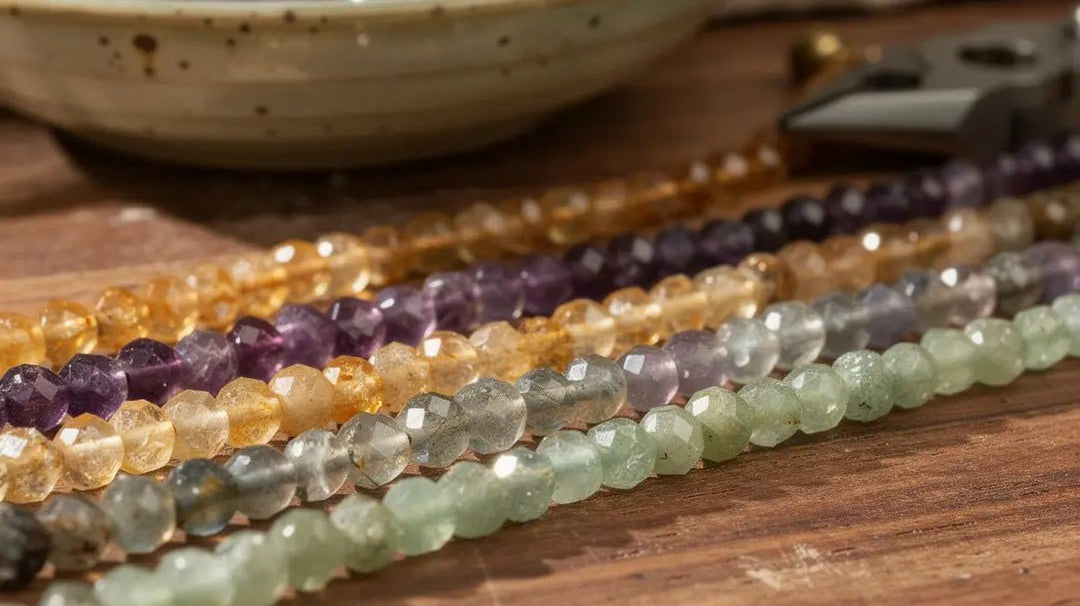
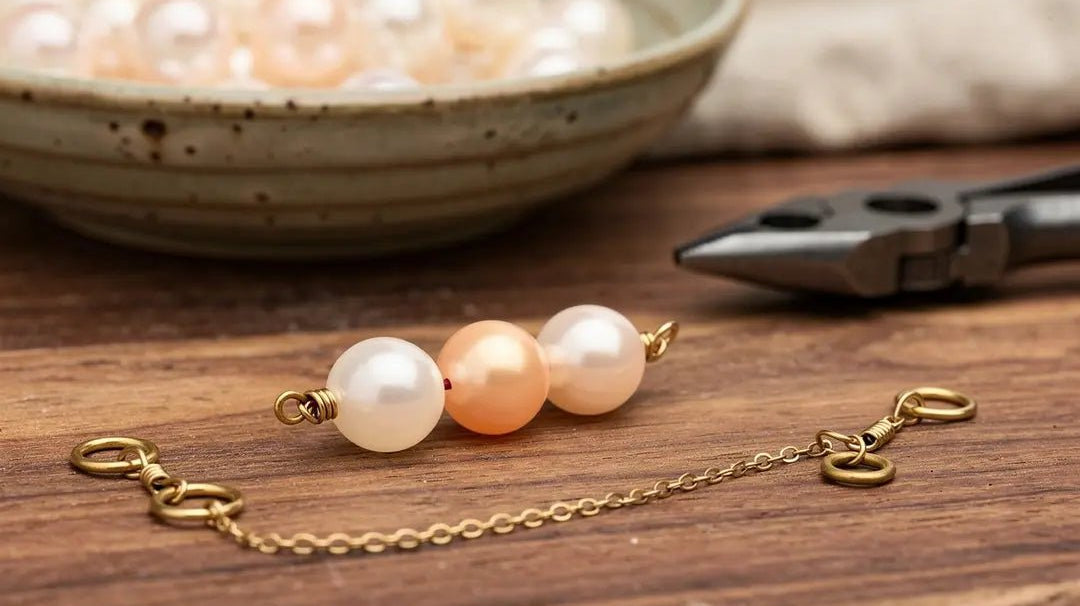
Choosing the right stringing material begins with understanding bead hole size. If the hole is too small, the cord won't pass through properly. If your hole is too large, beads can slide, shift, and sit incorrectly in your design. It's a small technical detail, but it's one that directly impacts durability, structure, and the overall finish of your jewelry.
In this bead size hole guide, we'll break down the typical hole diameters you'll find in gemstone beads. We'll also discuss how they vary by size, cut, and material. Learning how to match bead hole sizes with the right materials—elastic, thread, wire, or leather—allows each piece to function exactly as you intended.
Bead Hole Size Guide: Why the Right Fit Matters
Bead hole size affects more than just whether your cord fits properly. It directly impacts how your jewelry performs. If the hole is too tight, forcing material through can lead to fraying, weakening of the cord, or even stress the beads themselves. Too loose, and the beads can shift, spin, or sit unevenly, disrupting the balance of your design.
Additionally, as we note in our AAA gemstone beads guide, drilling quality is also an essential consideration in gemstone beads. Off-center or chipped holes don't just affect appearance; they weaken the structure of the bead entirely. Ultimately, clean, centered holes paired with the right stringing material creates a stable, professional finish.
Finally, fit matters for longevity. Tight or rough holes can wear down thread over time, whereas oversized holes allow excess movement that leads to friction between beads. Getting the right match helps keep pieces in quality condition, extending their lifespan for years to come.
If you're interested in learning more, read our guide, "Best Gemstone Beads for Jewelry Making."
Common Hole Sizes in Gemstone Beads
Most gemstone beads fall within a predictable range when discussing hole size. As a general rule, the hole diameter is roughly 10-15% of the bead's diameter. Therefore, a 4mm bead will typically have around a 0.6mm hole, a 6mm bead around 0.8mm, and an 8mm bead close to 1.0mm. This baseline is important to keep in mind when planning which stringing material you plan to use.
Remember: gemstones aren't uniform. Factors such as hardness, brittleness, and drilling technique all play a significant role in how the gemstone works in individual pieces. Softer stones, such as turquoise or amber, are easier to drill, resulting in larger or more consistent holes. Harder stones, however, like garnet or quartz, often result in smaller or less uniform holes.
Moreover, some beads are drilled from both sides, which can create slight misalignment and reduce the usable hole space. Our gemstone beads buyer's guide puts it plainly: small holes, typically 0.5mm to 0.8mm, are common in fine gemstone beads.
Freshwater pearls tend to be on the smaller end, around 0.5mm or less, since they're traditionally strung on silk. To better understand what this means, preview our Freshwater Pearl Beads Collection. In contrast, many standard gemstone beads fall in the 0.6mm to 1.0mm range, which is noticeably larger and allows for thicker staining materials, like wire or plastic.
Because of these variations, it's always worth checking the listed specifications before choosing your stringing material.
Choosing the Right Stringing Material for Gemstone Beads
There's no universal "best" stringing material. Ultimately, the right choice depends on bead hole size, bead weight, design specifications, and how the piece will be worn. Matching your material to the bead is what keeps the design both functional and long-lasting.
Here are the top stringing materials used for jewelry making with gemstone beads:
Elastic Cord
Elastic cords are the go-to option for stretch bracelets or kids' jewelry. It's an easy material to use and it doesn't require a clasp. However, it only works if the hole is large enough to accommodate the beads without force.
Generally, elastic cords come in 0.5mm, 0.8mm, and 1.0mm sizes. As a rule, ensure you use the thickest cord that fits comfortably through the hole. Doing so gives your piece additional strength and better snap-back over time. For 4mm-6mm gemstone beads with standard holes, 0.5mm elastic is usually appropriate. For 8mm beads or slightly larger holes, 0.7-0.8mm elastic provides better durability and stretch retention.
Make sure to always pre-stretch elastic before you begin stringing to prevent slack over time. Then, finish with a secure knot and a small amount of beading glue. Also, ensure you avoid crimp beads when using elastic, as they can cut through the cord over time.
For further information regarding making pieces with elastic cords, read: "How To Make High-Quality Jade Bead Bracelets."
Beading Thread
Thread is ideal for designs that require flexibility and movement, like knotted necklaces or bead weaving. There are a few designs to be aware of, especially because it's such a versatile material.
Silk is the traditional choice for pearls and softer stones because it's gentle and forgiving on bead holes. Nylon threads (like Nymo or KO), on the other hand, are thinner and work well for detailed designs like bead weaving. Finally, braided lines (like FireLine) are stronger and better suited for heavier besides or designs that require additional durability.
When choosing thread, it's important to match thickness and the material to your specific beads. Softer stones benefit from silk for softer synthetics, while harder stones may require something more durable. If your design requires multiple passes through the same bead, make sure the thread fits comfortably. Remember, forcing it can damage both the thread and bead.
For jewelry makers, you'll appreciate this guide next: "Crafting with Gemstone Beads: Step-by-Step DIY Jewelry Guide."
Wire
Wire strands work well for structured designs, wrapped loops, and pieces that need to hold their shape. However, the key is matching the correct gauge based on bead hole size. Here's a better breakdown:
- Fine gemstone beads and pearls with 0.5-0.8mm holes typically require 24-26 gauge wire.
- Medium gemstone beads with 0.8-1.0mm holes work well with 20-22 gauge wires.
- Larger beads above 1.2mm can often accommodate thicker 18-20 gauge wires.
For standard stringing (rather than wire-wrapping), beading cable is the preferred option. Finer cables (0.010-0.012 inch) suit smaller holes, while thicker cables (up to 0.024 inch) support heavier beads. Most importantly, always finish with crimp beads for a secure hold.
If you're not sure what size gemstone beads you have, visit our handy guide: "Gemstone Bead Size Chart."
Leather Cord
Leather cords add a natural, tactile look to pieces that other wire and thread can't replicate. However, it's important to note that because leather cord is thicker, it requires significantly larger bead holes. Most standard gemstone beads won't accommodate it.
Leather cord ranges from approximately 0.5mm to 5mm in thickness. A 1mm cord typically requires a bead hole size of at least 1.2-1.5mm to accommodate for natural variation in sizing (there's an industry tolerance of +/- 0.3mm in leather cord manufacturing). For a 2mm cord, you'll need beads specifically designed with large holes.
Pieces like our 12mm Red Banded Jasper Large Hole Faceted Round Beads are a great example of this. With an approximate 2.5mm hole diameter, they pair perfectly with thicker materials, like leather. Ultimately, beads such as these offer a completely different look and construction style compared to standard gemstone beads.
Large-Hole Beads: When to Use Them
Large-hole beads are designed for projects that standard gemstone beads cannot support. If you're working with thicker cords, multiple strands, or materials like leather, these beads give you the space you need to build without forcing a fit. Moreover, they're ideal for macramé-style designs, where the cord needs to pass through a bead and sit flush against knots on either side.
At The Bead Traders, our Large-Hole Gemstone Beads Collection includes options with approximately 2mm inside diameters across a range of stones. You can expect options such as lava rock, hematite, citrine, and peridot. Similarly, our Large-Hole Freshwater Pearls Collection serve the same purpose, with 2mm to 2.5mm holes in baroque and oval shapes.
A 2mm hole already significantly expands your options in designing pieces. More specifically, it can accommodate thicker beading wire, doubled thread, or some thinner leather collections. Once you move up to 2.5mm holes, like our 12mm Cornelian Orange Agate Large-Hole Rounds or our Dark Peacock Baroque 2.5mm Large-Hole Pearls, you can work with thicker materials and more complex closures.
If your design involves layering wrap bracelets or statement necklaces built on braided cords, large-hole beads are the right starting point. Trying to force a standard bead onto thicker materials can stress the bead at the drill point, leading to cracking over time
Tips for Measuring and Drilling Bead Holes
Before starting any project, it's worth confirming the actual bead's hole size rather than assuming based on bead diameter. A digital caliper is the most accurate tool for this. However, you can also use smaller drill bits as a simple gauge, testing different sizes until you find the largest one that fits without resistance.
Below, we will provide a bead hole size guide to help you with this process:
Measuring Bead Hole Size
Use a digital caliper to measure both the bead and the hole when possible. If the hole is too small to measure directly, insert the shank of a small drill bit and size up gradually. The goal is to find a snug fit, not to force anything through. This quick step helps you choose the right stringing material before you begin creating your piece.
Using a Bead Reamer
If your cord is only slightly too thick, a bead reamer can help widen the hole. Diamond-coated reamers are designed for this purpose and should always be used with water to reduce friction and heat. Work slowly, rotate gently, and ream from both ends toward the center. Avoid applying pressure, as forcing anything can crack the bead—especially if there are natural inclusions.
Drilling Bead Holes
For larger adjustments, proper drilling equipment is essential. Use a gemstone drill, stabilize the bead with putty, and keep the surface lubricated throughout the process. Additionally, ensure you wear eye protection. This is a precise, tool-dependent process, and without the right setup, it's easy to damage the stone.
You can learn additional information in our Gemstone Beads FAQ.
Test Before You String
Before committing to a full strand, test your stringing material through a few beads. This is especially important when working with a new stone type of unfamiliar cord. A quick test ensures the fit is right, which is important in helping you avoid issues later in the design process.
Use this bead hole size guide to match gemstones to the appropriate stringing material.
Aside from fit and comfort, following a bead hole size guide can make the difference between a piece that holds up well and one that doesn't. Once you know what bead hole size you're working with, you can better match it to the correct cord, wire, or thread, creating jewelry that is of the highest quality.
If you're ready to put this bead hole size guide into practice, browse our full gemstone beads collection and see what's just landed in our new arrivals. Orders over $100 ship free within the U.S., and we ship worldwide.