The terms "onyx," "onyx marble," and "banded calcite" are often used interchangeably. However, they don't refer to the same stone. Walk through any bead shop, and you'll find everything from black onyx to green onyx bead and gemstone options. While they may share a similar name, their composition, durability, and intended uses are very different.
The biggest source of confusion is that much of what's sold as onyx marble is actually banded calcite, a softer decorative stone that's marketed under a long-established trade name. By contrast, true onyx is a variety of chalcedony, a durable form of quartz prized for its strength and suitability for jewelry.
In this guide, we're helping you decipher the differences by comparing onyx vs. marble. We'll explain why banded calcite isn't true onyx and discuss the differences in appearance, hardness, durability, and jewelry application. By the end, you'll know exactly what you're looking for and how to choose the right stone for your project.
Onyx vs Marble: What Is the Real Difference?
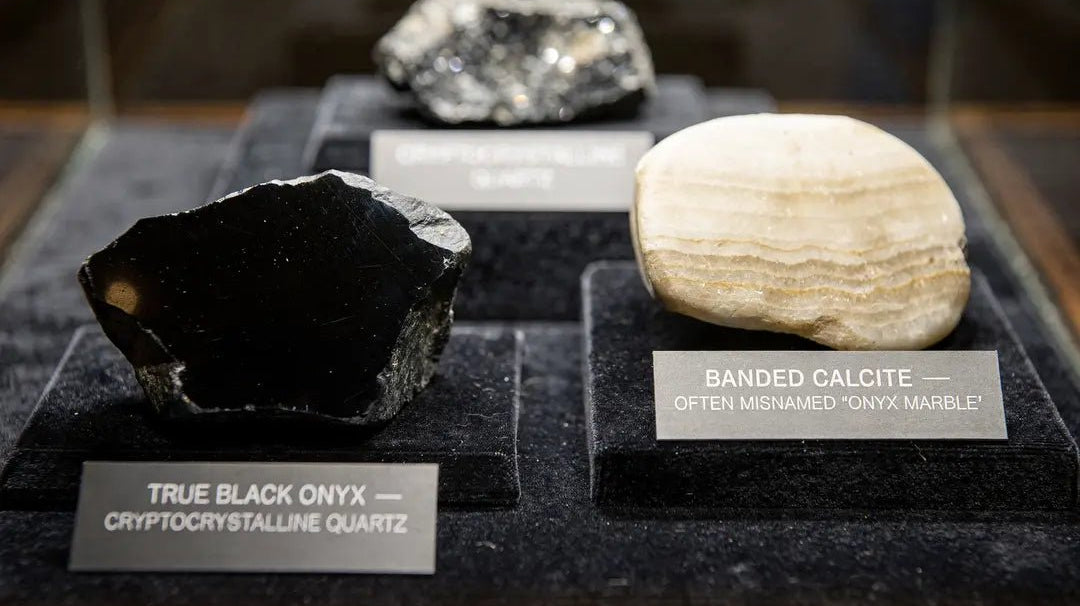
The biggest difference between onyx and marble comes down to mineral composition. True onyx is a variety of chalcedony, while marble is a metamorphic rock made primarily from calcite. To make matters more confusing, many decorative products marketed as "onyx marble," aren't untrue; they're typically banded calcite sold under a long-established trade name.
But what does this all mean? Here's a comprehensive breakdown of how true onyx and marble are different:
True Onyx Is a Variety of Chalcedony
True black onyx is a variety of chalcedony, a microcrystalline form of quartz composed of silicon dioxide. Its dense structure allows it to take on a smooth, glass-like polish while remaining durable enough for everyday jewelry. Although naturally banded onyx exists, the solid black onyx commonly used in jewelry is often treated to achieve its rich, uniform color.
Because of its durability and polished appearance, black onyx is a popular choice for gemstone beads, cabochons, pendants, and other jewelry components. At The Bead Traders, you'll find a variety of black onyx beads in a variety of shapes, sizes, and finishes for everything from minimalist designs to bold statement pieces.
Marble Is a Calcite-Based Rock
Marble forms when limestone or dolostone is transformed by heat and pressure over millions of years. The result is a metamorphic rock composed primarily of calcite, giving marble its distinctive veining and soft, elegant appearance.
While marble has long been prized for sculptures, architectural details, countertops, and decorative objects, it isn't commonly used for everyday jewelry. With a hardness of approximately 3 on the Mohs Hardness Scale, marble scratches much more easily than quartz-based gemstones and requires gentler handling.
"Onyx Marble" Is a Decorative Trade Name
Often, the greatest source of confusion is the term "onyx marble." Despite the name, this material is banded calcite (and occasionally banded aragonite) rather than true onyx. It's also commonly marketed as "Mexican onyx," "Pakistan onyx," or "green onyx," particularly in home décor and carved decorative objects.
The name became popular because the stone's translucent bands resemble the layered appearance of some varieties of onyx and agate. Gemologically, however, the materials are entirely different. True onyx belongs to the quartz family, while banded calcite is a calcium carbonate mineral with significantly different hardness, durability, and care requirements.
Understanding that distinction helps you choose the right material for your jewelry, decorative projects, or gemstone collecting.
Why Is Banded Calcite Called "Onyx Marble"?
Banded calcite is commonly called "onyx marble" because its translucent layers and flowing bands resemble some varieties of onyx. Although the two materials belong to entirely different mineral families, the visual similarities led the decorative stone industry to adopt the name decades ago. Today, the trade term remains widespread, especially for carved home décor and architectural stone.
Here's a closer look at how "onyx marble" earned its name:
Its Appearance Resembles Onyx
One reason for the confusion is that polished banded calcite can be remarkably beautiful. More specifically, it often displays parallel or flowing bands in shades of cream, honey, amber, green, brown, and white, with a translucent quality that allows light to pass through portions of the stone.
While this layered appearance may resemble certain forms of onyx at first glance, the resemblance is purely visual rather than mineralogical.
The Name Became Popular in the Decorative Stone Trade
The term "onyx marble" originated in the decorative stone industry, where materials are often marketed by their appearance rather than their scientific classification. Because banded calcite is relatively soft, easy to carve, and capable of taking on a beautiful polish, it became a popular choice for bowls, vases, trays, lamps, and architectural accents. Over time, the familiar name "onyx" became associated with these decorative pieces, even though the material isn't true chalcedony onyx.
For jewelry makers and gemstone collectors, understanding this distinction is important. A stone marketed as "onyx marble" may be beautiful, but it won't offer the durability, hardness, or wear resistance as genuine onyx.
How Can You Tell Black Onyx from Banded Calcite?
You can usually distinguish black onyx from banded calcite by evaluating several characteristics together, including color, pattern, hardness, and overall durability. While the two materials may sometimes look similar at a glance, their composition and performance are quite different.
Here's how those differences between black onyx and banded calcite show up:
Compare the Color and Pattern
True black onyx is typically a deep, opaque black, although some varieties display subtle black-and-white banding. It has a smooth, uniform appearance that reflects its fine-grained chalcedony structure. At The Bead Traders, you'll find examples in our classic Black and White Onyx Beads.
Banded calcite, often sold as onyx marble, usually displays translucent layers in shades of cream, honey, amber, green, brown, or white. Some decorative materials marketed as "green onyx" or "tri-color onyx" feature these flowing bands, which are characteristics of calcite rather than true onyx.
Check the Hardness and Durability
One of the biggest differences between onyx and marble is hardness. True onyx, as a variety of chalcedony, ranks approximately 6.5 to 7 on the Mohs Hardness Scale, making it durable enough for everyday jewelry. Banded calcite, on the other hand, ranks around 3 on the Mohs Hardness Scale, making it significantly softer and more susceptible to scratches, chips, and everyday wear.
Understand Acid Sensitivity
Calcite reacts differently to acids. Because it's a calcium carbonate mineral, exposure to mild acids such as vinegar or lemon juice can cause etching or a slight fizzing reaction. Conversely, chalcedony onyx doesn't react this way. However, it's best not to perform acid tests on finished jewelry or valuable gemstones, as doing so can permanently damage the material.
If you're uncertain about a stone's identity, consult a qualified gemologist or purchase from a reputable supplier that clearly identifies its materials and any treatments.
Which Material Is Better for Jewelry Making?
For most jewelry applications, true black onyx is the more practical choice. Its greater hardness and durability allow it to withstand everyday wear, making it well-suited for pieces that are worn frequently. Banded calcite, while stunning, is much softer and is generally better reserved for designs that won't be as exposed to as much impact or abrasion.
Best Uses for Black Onyx Beads
Black onyx is a versatile gemstone that works beautifully in everything from stretch bracelets and beaded necklaces to minimalist earrings and male-inspired designs. Additionally, its rich black color pairs effortlessly with Freshwater Pearls for timeless contrast, while gold-filled or sterling silver metal beads and findings create a clean, sophisticated finish. It also complements a wide variety of other gemstone beads, making it an excellent foundation for both classic and contemporary jewelry styles.
Best Uses for Banded Calcite
Banded calcite is best showcased in jewelry where its translucent layers and natural banding can take center stage without being subjected to constant wear. Pendants, statement necklaces, decorative cabochons, and earrings are all excellent options, particularly when the stone is set in a way that helps protect its softer edges. Because of its lower hardness, it's generally less suitable for rings, stretch bracelets, or other pieces that experience frequent impacts.
Design Pairing Ideas
Black onyx offers remarkable versatility in jewelry designs. For example, pair it with freshwater pearls for an elegant light-and-dark contrast, combine it with colorful gemstone beads for added depth, or incorporate it into layered necklace designs using delicate Chain By the Foot. Its neutral black tone complements virtually every metal finish and gemstone, making it one of the easiest materials to build a cohesive collection around.
Find even more inspiration by reading "Gemstone Bead Color Combinations Using Color Theory."
Does "Fake Onyx" Mean the Stone Has No Value?
No, calling a stone "fake onyx" doesn't necessarily mean it's worthless. In fact, in many cases, the material is genuine banded calcite that's simply being marketed under the trade name "onyx marble." The issue isn't that the stone lacks beauty or value; it's that it should be accurately identified so buyers know what they're purchasing.
Here's what matters when shopping for black onyx beads:
Mislabeling Isn't Always Intentional
Trade names can be confusing, particularly in the decorative stone industry, where names often reflect appearance rather than mineral composition. Some sellers may use terms like "onyx marble," "Mexican onyx," or "green onyx" simply because they're widely recognized. In other words, they're not necessarily trying to mislead customers. Even so, reputable suppliers should be able to tell you exactly what the material is and disclose any treatments or trade names used.
Could you use a little additional guidance? Read our post, "How to Buy Wholesale Gemstone Beads Online with Confidence."
Value Depends on Accurate Information
Every gemstone or ornamental stone has value when it's represented honestly. Banded calcite, for example, is admired for its beautiful translucency, flowing bands, and ease of carving. Because of this, it's an excellent choice for decorative objects and select jewelry designs. Conversely, true black onyx commands different expectations because its greater hardness and durability make it better suited for everyday jewelry.
Rather than asking whether a stone is "real" or "fake," it's more appropriate to ask whether it's accurately identified. When you know whether you're buying chalcedony onyx or banded calcite, you can better understand its durability, care requirements, and fair market value. And, most importantly, the more confident you'll feel in choosing the right material for your project.
What Should You Look for When Buying Black Onyx Beads?
When shopping for black onyx beads, it's important to look beyond color alone. A reputable supplier should clearly identify the gemstone, provide detailed product information, and offer high-quality strands that are suitable for jewelry making. Knowing exactly what you're buying helps you choose the right material and confidently describe it to your own customers.
When buying black onyx beads, here's what to look for:
Look for Clear, Accurate Labeling
One of the easiest ways to avoid confusion is to purchase from suppliers that accurately identify their gemstones. Product descriptions should clearly distinguish black onyx from banded calcite, chalcedony, agate, glass, and other look-alike materials.
If you come across names such as "green onyx," review the description carefully to determine what the material is. Transparent labeling, like we use in our Green Onyx Faceted Rondelles and Shaded Green Onyx Rondelles allow you to make more informed purchasing decisions.
Evaluate Jewelry-Making Quality
For jewelry makers, consistency matters. Check that the beads have a smooth polish, uniform sizing, clean drill holes, and a well-matched strand. These details make stringing easier, help your finished pieces look more professional, and reduce wasted time sorting beads. It's also helpful to confirm that the drill hole size is compatible with your preferred cord, wire, or beading thread.
If you're new to jewelry making, you may find this post helpful: "Bead Hole Size Guide: Match Gemstone Beads to Cord Type."
Buy From a Trusted Gemstone Supplier
At The Bead Traders, you'll find a carefully curated selection of onyx beads alongside clearly labeled chalcedony beads and other gemstone bead options. Whether you're looking for classic black onyx or distinctive patterned onyx, detailed product descriptions help you choose the right beads for every design. You'll also find freshwater pearls, metal beads and findings, chain by the foot, and other jewelry-making essentials, making it easy to source everything you need in one place.
And don't forget: U.S. orders over $100+ receive free shipping and returns!
Frequently Asked Questions About Onyx vs. Marble
Is black onyx always natural?
Not always. Much of the black onyx used in jewelry is genuine chalcedony that has been dyed or heat-treated to achieve a rich, uniform black color. However, these treatments are incredibly common and widely accepted within the gemstone industry. If you're looking for untreated material, review the product description carefully and purchase from a supplier that clearly discloses any enhancements.
Is green onyx real onyx?
It depends on the material being sold. In the decorative stone industry, "green onyx" often refers to banded calcite rather than true onyx. However, some jewelry suppliers also use the name for dyed green chalcedony. Because the trade name can refer to different materials, it's always best to check the product description and verify the gemstone's actual identity before purchasing.
Can onyx marble be used in rings?
Yes, but it's generally not the best choice for everyday rings. Most onyx marble is banded calcite, which ranks around 3 on the Mohs Hardness Scale and is more susceptible to scratches and chips than true onyx. If you choose banded calcite jewelry, it's best suited to occasional-wear rings or designs with protective settings.
Does black onyx scratch easily?
Not under normal wear. As a variety of chalcedony, black onyx ranks approximately 6.5 to 7 on the Mohs Hardness Scale, making it significantly more scratch resistant than calcite. While it can still be scratched by harder gemstones or abrasive materials, it's durable enough for everyday jewelry when cared for properly. Store black onyx separately from harder stones such as sapphire or diamond to help preserve its polished finish.
Choose the stone that matches your gemstone bead project with The Bead Traders.
The onyx vs. marble comparison ultimately comes down to choosing the right material for the right purpose. True black onyx offers the durability, polish, and everyday wearability that make it a favorite for jewelry, while banded calcite, often sold as "onyx marble," is prized for its soft translucency and decorative beauty. Neither stone is inherently better; the key is understanding what you're buying and choosing a material that matches your project and expectations.
Pick based on your project. For durable beads, start with our gemstone beads, then add freshwater pearls, metal findings, and chain by the foot. Additionally, don't forget to check the new arrivals for the latest additions to your next design.