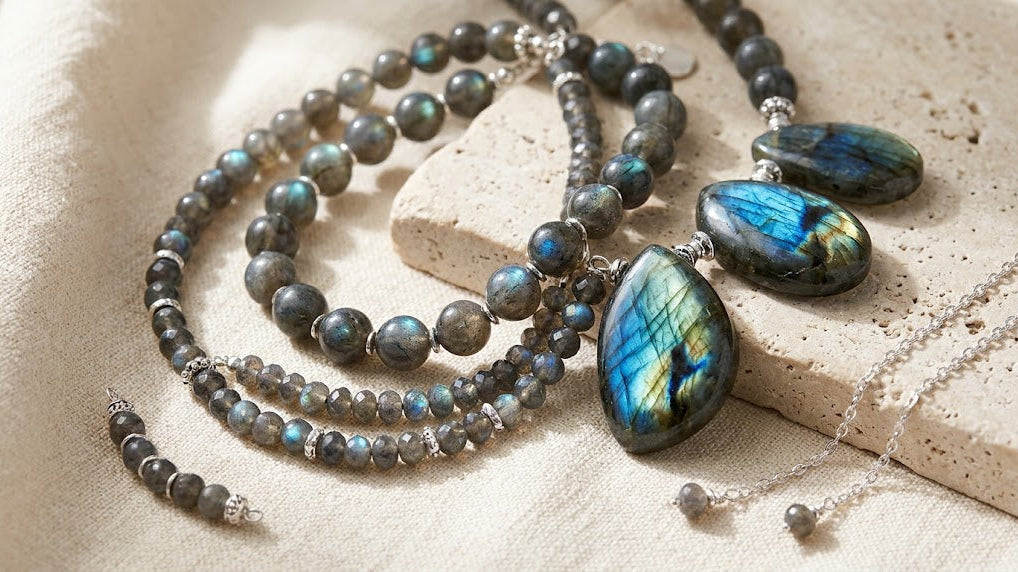
At first glance, labradorite might look like an ordinary gray gemstone. But turn it slightly toward the light, and suddenly, brilliant flashes of blue, green, gold, or even purple appear across its surface. It’s this unexpected display of color that makes labradorite such a favorite jewelry among makers and gemstone collectors.
Beyond its appearance, labradorite meaning is closely tied to transformation, intuition, and personal growth. Its shifting colors have inspired stories and symbolism for centuries, adding another layer of interest to an already beautiful stone.
Whether you’re drawn to its symbolism or simply love the way it looks in jewelry, here’s what to know about labradorite, including its properties, history, and how to incorporate it into your designs:
What Is Labradorite?
Labradorite is a naturally occurring gemstone belonging to the feldspar mineral family. More specifically, it’s a calcium-rich plagioclase feldspar, named after Labrador, Canada, where it was identified in the 18th century. Most labradorite has a gray, charcoal, or dark body color, but its defining feature is an optical phenomenon called labradorescence.
What Causes Labradorite’s Color Flash?
Labradorescence occurs when light enters the gemstone and interacts with thin internal layers in its mineral structure. As light reflects between these layers, it creates flashes of color that seem to move across the stone as you change the angle you view it at.
Most people see blue and green, but some specimens display gold, orange, purple, or several colors at once. And unlike surface coatings or glitter, these flashes come from within the stone itself.
Labradorite also measures approximately 6-6.5 on the Mohs hardness scale. This makes it suitable for many types of jewelry, although its natural cleavage means it can chip or fracture if struck hard enough.
Labradorite Meaning and Symbolism
Labradorite is often called a stone of transformation, and much of its symbolism comes from the way it looks. A seemingly ordinary gray stone can reveal remarkable colors when viewed from a different angle. For many people, that makes a labradorite a fitting symbol of hidden potential, self-discovery, and the changes that come with personal growth.
In modern crystal traditions, the most common labradorite meanings include:
-
Transformation: Embracing change, new beginnings, and personal growth
-
Intuition: Trusting your instincts and developing greater self-awanress
-
Protection: Symbolically guarding against unwanted energy and maintaining personal boundaries
-
Creativity: Encouraging imagination, inspiration, and new perspectives
-
Inner Strength: Recognizing your capabilities, particularly during uncertain times.
Because of these associations, labradorite jewelry is sometimes given as a meaningful gift to celebrate a new job, a major milestone, or another important life transition. If you’re interested in using this gemstone in your own work, you may appreciate our full buying guide for labradorite gemstone beads.
Labradorite Healing Properties and Spiritual Uses
Labradorite also has a place in spiritual practices, where it’s commonly associated with intuition, reflection, and emotional balance. Some people wear labradorite jewelry as a personal reminder to stay grounded during periods of change. Others incorporate polished stones into meditation or keep them nearby while journaling or practicing mindfulness.
These healing and protective associations are based on spiritual traditions rather than scientific evidence. While labradorite can hold personal meaning, it hasn’t been shown to provide medical or psychological benefits.
Labradorite History and Folklore
Labradorite has a particularly interesting connection to the Northern Lights. One widely repeated legend tells of the Aurora Borealis becoming trapped inside rocks along the Labrador coast. According to the story, a warrior struck the stone and released the lights into the sky, although some of their brilliance remained within the rock.
It’s a fitting story for a gemstone that seems to hold flashes of light beneath its surface. However, versions of this legend are often attributed broadly to Inuit folklore, and its specific historical origins aren’t well documented.
Labradorite was formally described by European mineralogists in the 18th century after specimens were collected in Labrador, Canada. Today, the gemstone is also sourced from locations including Madagascar, Finland, and Russia. Finland is especially known for a variety of labradorite marketed as spectrolite, which can display particularly vivid, multicolored flashes of light.
Labradorite Uses in Jewelry Making
For jewelry makers, labradorite offers plenty of creative possibilities. Its smoky gray base pairs easily with other gemstones, while its flashes of blue, green, and gold bring something unexpected to finished pieces.
At The Bead Traders, you’ll find a wide selection of labradorite gemstone beads, including faceted rounds, rondelles, teardrops, nuggets, and larger focal stones. Whether you’re creating delicate everyday jewelry or a statement piece, there’s plenty to work with.
Labradorite Necklaces
Labradorite works beautifully in everything from simple gemstone strands to elaborate layered necklaces. For understated designs, try 4mm microfaceted rounds or hand-faceted rondelles. These smaller beads work well on their own or paired with moonstone for a softer, luminous finish.
Larger labradorite nuggets and faceted coins make beautiful centerpieces. You can also explore our gemstone focal beads for a pendant that draws attention without requiring an elaborate design.
Labradorite Bracelets
A strand of labradorite rounds makes a beautiful bracelet on its own, especially when paired with a few metallic spacers. For more color, consider mixing labradorite with amethyst or black onyx beads. Amethyst complements the stone’s occasional purple flashes, while black onyx creates a darker, more understated look.
You can also experiment with different finishes. Matte labradorite beads, for example, create an earthy, subdued appearance alongside faceted options that catch more light. Because bracelets experience more wear than necklaces, use quality stringing materials and avoid designs that leave the beads vulnerable to frequent impacts.
Labradorite Earrings and Pendants
Earrings are especially well suited to labradorite because their natural movement helps reveal the gemstone’s changing colors. At The Bead Traders, we offer faceted oval beads, teardrops, and marquise-shaped focal stones that work beautifully in drop earrings.
For example, a 20x10mm Labradorite Faceted Marquise Focal features flashes of blue, teal, green, and gold, making them an eye-catching choice for statement designs. Larger focal beads also work well for pendants. A single labradorite stone on a simple chain can be just as striking as a more intricate design.
How to Design With Labradorite Beads
One of the best things about labradorite is how easily it works with different materials. You can create an elegant, minimalist piece or something much more colorful simply by changing the surrounding beads and findings.
Choose Metals That Complement the Flash
Silver is a natural match for labradorite, especially stones with prominent blue and green flashes. Sterling silver, oxidized silver, and gunmetal findings all complement its color tones. For a warmer look, try gold, brass, or copper. These metals create beautiful contrast against labradorite’s gray body color and work particularly well with golden flashes.
Pair Labradorite With Other Gemstones
If you’re looking for complementary materials, The Bead Traders natural gemstone bead collection offers plenty of options. A few combinations worth experimenting with include:
-
Moonstone: Creates a soft, luminous combination that works beautifully in layered necklaces
-
Black Onyx: Adds contrast for a sleek, monochromatic jewelry
-
Amethyst: Introduces rich purple tones that complement labradorite’s cooler flashes
-
Iolite: Emphasizes blue and violet for a coordinated design
-
Freshwater Pearls: Balance labradorite’s dramatic color play with a classic finish
-
Citrine: Adds warmth, particularly alongside labradorite with golden flashes
You don’t need to combine several gemstones in one piece, either. Sometimes, a few moonstone rondelles or black onyx accents are enough to make labradorite stand out.
Experiment with Different Bead Shapes
Bead shape can completely change the appearance of labradorite jewelry. Smooth rounds are ideal for classic bracelets, while rondelles are particularly useful for layered necklaces and gemstone chains.
For more distinctive designs, try faceted marquise beads, irregular nuggets, or a gold-leafed labradorite pendant. These shapes give you an opportunity to create jewelry that feels a little less traditional.
How to Choose Quality Labradorite Beads
Not all labradorite beads look alike, even when they come from the same strand. Some have bright, concentrated flashes of blue, while others display softer green or gold tones. You may also notice differences in the amount of color visible from one angle to another.
That variation is normal and part of the appeal of working with natural gemstones. When shopping for labradorite beads, pay attention to a few details:
-
Color Flash: Look for flashes that are visible under normal lighting, especially if labradorescence is central to your design.
-
Surface Quality: Check for a smooth, even polish and avoid beads with significant chips or fractures.
-
Size Consistency: Uniform beads are helpful for symmetrical jewelry designs.
-
Drill Holes: Holes should be clean and properly positioned for easy stringing.
-
Product Descriptions: Check the listed dimensions, strand length, treatments, and other material details.
Keep in mind that a bead doesn’t need to display every color of the rainbow to be attractive or genuine. Some designs benefit from the quieter appearance of gray labradorite with occasional flashes of color. If you need additional guidance, make sure to check out our gemstone beads buying guide.
How to Care for Labradorite Jewelry
Labradorite is durable enough for many jewelry applications, but it still needs some care to prevent scratches and chips. With a Mohs hardness of approximately 6-6.5, it’s softer than gemstones such as quartz and sapphire. Its natural cleavage also makes it vulnerable to sharp impacts.
To keep labradorite jewelry looking its best:
-
Clean it gently with warm water, mild soap, and a soft cloth
-
Avoid ultrasonic cleaners, steam cleaning, and harsh chemicals
-
Remove bracelets and rings before exercise, cleaning, or other activities where they might be struck
-
Dry jewelry thoroughly before putting it away
-
Store labradorite separately from harder gemstones to prevent scratches
Earrings, necklaces, and pendants are particularly good choices because they typically experience less wear than rings and bracelets.
Labradorite vs. Moonstone: What’s the Difference?
Labradorite and moonstone are both members of the feldspar mineral family, but their appearances are quite different.
Labradorite is generally darker, with distinct flashes of blue, green, gold, or other colors. Moonstone is often white, cream, peach, or gray and is known for a softer, floating glow called adularescence.
Their symbolism also differs. Labradorite is commonly associated with transformation and protection, while moonstone is traditionally linked to new beginnings, balance, and reflection. One detail that can be confusing when shopping for beads is rainbow moonstone. Despite its trade name, this material is generally a variety of white labradorite rather than traditional moonstone.
Both gemstones are beautiful options for jewelry making, but labradorite tends to create a more dramatic, high-contrast look.
Frequently Asked Questions About Labradorite
What Is the Meaning of Labradorite?
Labradorite meaning is commonly associated with transformation, intuition, protection, creativity, and self-discovery. These symbolic interpretations come primarily from modern crystal and spiritual traditions.
What Is Labradorite Used For?
Labradorite is widely used in necklaces, bracelets, earrings, pendants, and decorative objects. Some people also use it symbolically during meditation or personal reflection.
Is Labradorite Good for Everyday Jewelry?
Yes, although some jewelry styles are better suited to regular wear than others. Labradorite necklaces and earrings are generally easier to protect, while rings and bracelets require additional care to avoid scratches and impacts.
Can Labradorite Go in Water?
Brief contact with lukewarm water is generally fine when cleaning labradorite. However, prolonged soaking, harsh cleaning solutions, and sudden temperature changes should be avoided.
Explore Labradorite Gemstone Beads at The Bead Traders
Between its beautiful color flashes and its symbolism of transformation, labradorite offers plenty of inspiration for jewelry makers. You can keep things simple with a strand of smooth rounds, combine it with complementary gemstones, or make a single high-flash bead the centerpiece of your design.
At The Bead Traders, you can explore our labradorite gemstone beads for different shapes, sizes, and finishes. We also offer metal beads and findings and chain by the foot, so you can find everything you need to bring your jewelry designs to life in one place. Explore our new arrivals; U.S. orders over $100 get free shipping.