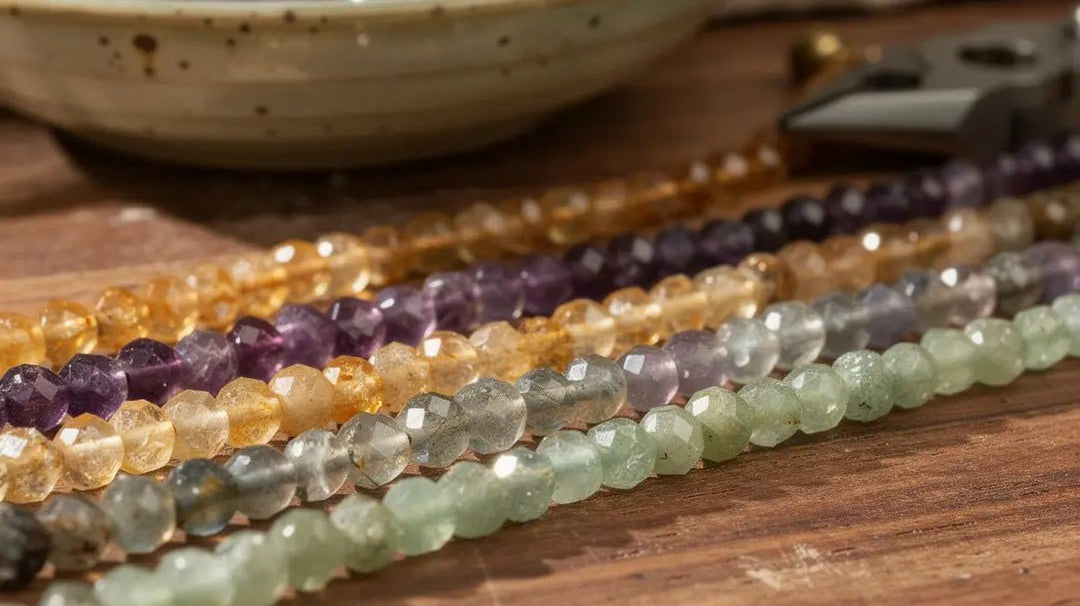
Natural, dyed gemstone beads, and heat-treated stones are among the most common materials you'll encounter when shopping for gemstone beads. However, they're often sold side by side without a clear distinction, making it difficult to tell exactly what you're buying.
This is where understanding gemstone treatments becomes essential. From dyed gemstone beads that enhance or alter color to heat-treated stones that improve clarity, each process plays a role in how a bead looks, performs, and is value in the market.
In this guide, we will break down the differences between natural, dyed, and heat-treated gemstone beads. We will also explore how to identify each type and what to look for when sourcing materials. Whether you're designing jewelry or purchasing strands for a collection, understanding how to evaluate these variations helps you chop with confidence.
Why Gemstone Treatments Matter
Treatments are everywhere in the gemstone bead trade, and understanding them is essential when sourcing materials. According to the Gemological Institute of America (GIA), treated gemstones may require special care. When treatments aren't disclosed, buyers can easily assume a stone is of higher quality than it actually is.
This is because treatment directly affects a gemstone's appearance, durability, and value in this market. And in many cases, the more intensive the treatment, the greater the impact on value. This can become a particular issue for buyers creating jewelry to gift or sell.
For example, a heat-treated blue sapphire can appear nearly identical to an unheated one, yet the price difference between the two can be significant.
This doesn't mean treated stones are inherently bad. In fact, many treatments are accepted across the industry. However, disclosure is key. When you know exactly what your'e buying, you can evaluate it properly, price it accurately, and use it with confidence.
For those unsure of the process, follow our guide, "Identify Real Natural Stone Beads."
What Are Dyed Gemstone Beads (and Why Are They So Common?)
Dyed gemstone beads are natural stones that have been enhanced with added color through a dyeing process. This treatment can intensify a stone's existing hue, completely change its color, or create a more uniform appearance across an entire strand.
Ultimately, dyeing increases the range of available materials in the market, allowing lower-cost stones to mimic the look of more expensive gem varieties. That accessibility is a major reason why dyed gemstone beads are so widely available, and often more affordable than their natural counterparts.
The effectiveness of dyeing largely depends on a stone's porosity. Gemstones with internal voids or micro-fractures, for example, absorb dye more easily. This is often why chalcedony, agate, howlite, and turquoise are among the most commonly dyed materials.
You can learn more in our guide, "Natural vs. Dyed Coral Beads: How to Spot the Difference."
How Dyeing Is Done
The dyeing process for gemstones is relatively straightforward. However, results can vary depending on the material. After stones are cut, tumbled, and polished, they're typically soaked in dye solutions for anywhere from several days to a few weeks. In most cases, the color doesn't penetrate the stone entirely, sitting closer to the surface. That's why if a dyed bead is scratched or chipped, you'll often see the natural, undyed material underneath.
In some cases, stones undergo an additional heat-and-quench process before dyeing to help the color absorb more deeply. Clear quartz, for example, is commonly heated and then rapidly cooled in a dye solution, creating tiny internal fractures that allow dye to travel further into the stone. This process produces what is known as "crackle quartz."
Durability is another important factor to consider with dyed gemstone beads. According to the GIA, many dyes can fade over time with prolonged sun exposure, while others may be affected by chemicals such as alcohol or acetone.
To preserve a gemstone's color, keep it away from harsh cleansers and extended UV exposure. This is especially important for everyday-wear jewelry.
Heat Treatment Basics
Heat treatment is one of the oldest and most widely accepted gemstone enhancements in existence. Historical research shows that artisans in India were heating chalcedony to produce carnelian as early as 2000 BC. Today, it's standard practice across the industry.
Heat treatment involves exposing a stone to carefully controlled high temperatures, typically ranging from 500°C and 1800°C, in specialized furnaces. This process alters the stone's internal structure, dissolving certain inclusions, shifting the valence state of coloring elements, or reducing unwanted hues. This result is often a more desirable color, improved clarity, or a combination of both.
Some of the most well-known heat-treated gemstones include ruby and sapphire. Through heating, rubies lose their purplish undertones to become a cleaner red, while sapphires’ blue hues become more vivid and saturated. Additionally, tanzanite is almost always heated to eliminate its natural brownish tint and reveal the vibrant purplish-blue hue that it's known for. For a better depiction of this, review our tanzanite stone beads selection.
Unlike dyeing, heat treatment doesn't introduce any foreign material into the stone. It works with the stone's existing chemistry, which is one reason it's widely accepted as a legitimate enhancement even at the high end of the market.
Stabilization 101: Why Some Gemstones Need Extra Support
Some gemstones are simply too porous or fragile to hold up in jewelry without extra help. Stabilization addresses this by introducing a bonding agent, typically a resin or polymer, into the stone's pore structure. This process creates a harder, denser, and less absorbent material, making the gemstone far more durable and suitable for everyday wear.
Turquoise is one of the most well-known examples of stabilized stones. In fact, according to research, approximately 90% of turquoise on the market today it's stabilized. Because of this, it's safe to assume treatment unless a stone is specifically labeled as natural.
However, this isn't a bad thing. Without stabilization, turquoise is highly absorbent and prone to discoloration from oils, moisture, or regular handling.
It's also important to note that stabilization is not the same as dyeing. Stabilization reinforces the structure of the stone, helping it preserve its natural color. On the other hand, dyeing alters the color of the stone itself. Properly stabilized turquoise maintains a consistent color over time, whereas dyed stones may fade or bleed under certain conditions.
For those interested, learn more about the history of natural turquoise beads on The Bead Traders. You can also visit our website to shop real turquoise beads at reasonable prices.
Spotting Treated vs. Untreated Stones
When evaluating gemstone beads, there are a few key visual cues that can help you identify whether a strand is natural, dyed, or treated. While no single sign tells the full story, patterns like these can give you a much clearer picture of what you’re working with:
Visual Indicators to Look Out For
These are the main things to check when you're evaluating a strand:
- Color that looks too uniform: If every bead is exactly the same shade with no variation, it’s worth questioning. Natural gemstones typically show slight differences in tone, pattern, or saturation from bead to bead.
- Color that bleeds when wet: Lightly dampen a bead or rub it with a damp cloth. If any color transfers, it’s a strong indication the stone has been dyed.
- Stained thread or wire: Check the string running through the beads. If it’s picked up color, the dye may be leaching out over time.
- Chipping or flaking near the drill hole: This can signal imitation materials or heavily coated beads rather than solid natural stone.
- Beads that feel warm to the touch: Genuine stone tends to stay cool longer, while glass or plastic warms up quickly in your hand.
- Unnaturally bright or saturated color: On stones like howlite or magnesite, extremely vivid color is often a sign of dye rather than natural formation.
For heat-treated stones, the indicators are much more subtle. You may notice overly consistent color with minimal natural variation, or stones that appear exceptionally clear with few to no inclusions. Under magnification, features like that halos or surface-reaching fractures can sometimes point to high-temperature treatments. However, these signs are not always visible without proper tools.
Questions to Ask Your Retailer
A reputable gemstone bead supplier should be transparent about what they’re selling. If you’re unsure about a strand, asking a few direct questions can quickly clarify whether you’re working with natural or treated material:
- Has this stone been dyed, stabilized, or heat-treated?
- Where does this stone come from?
- Is the treatment permanent, or does it require special care?
Clear, confident answers to these questions are a good sign you’re dealing with a knowledgeable and trustworthy seller. If a retailer avoids the question or gives vague responses, that’s worth paying attention to. Disclosure isn't optional in the gemstone trade, it's standard practice among reputable sellers.
For further context, visit our Gemstone Beads Buyer's Guide. Here, we discuss what to look for, how to evaluate quality, and key questions to ask before making a purchase.
Shopping Dyed Gemstone Beads: Key Considerations
Dyed gemstone beads are a legitimate and practical choice for many jewelry projects. The key is knowing what you're getting and paying a price that reflects it. Here's how to approach the purchase.
Price vs. Quality
Treated gemstone beads typically cost less than untreated stones of similar appearance. That price difference isn't inherently a drawback. For fashion jewelry, prototyping designs, or projects where consistent color matters, treated stones can be a practical, cost-effective choice.
Ultimately, the key is to align your materials with your intended use. Transparency is everything. If you're creating pieces to sell, representing whether a stone is natural, dyed, or heat-treated isn't just best practice. It's an essential step in building trust with your customers. More importantly, it reflects the true value of your work.
For fashion jewelry, larger collections, or designs where uniform color matters, treated stones like dyed agate or chalcedony can be a smart, intentional choice. For one-of-a-kind pieces or designs where natural variation is part of the appeal, untreated stones may be more aligned with that goal.
You may find this guide particularly helpful: "AAA Gemstone Beads: What the Grade Means for Your Craft."
Transparency and Trust in Retailers
Look for sellers who include treatment information in their product descriptions, not just on request. Also, ensure you check the return policy. A seller who stands behind their products will offer reasonable returns. At The Bead Traders, treatments are disclosed upfront and we offer free shipping and free returns on orders over $100 in the US.
Moreover, at The Bead Traders, we operate on our 3 Promise “VALUE PLEDGE.” This means that when shopping with our company, you can expect:
- Our Power Buys Save You Money: We purchase bulk beads and value gems, allowing us to maintain our competitive price for extended periods of time. As a result, you can access our inventory as a consistent price point, saving you money in the long run.
- The "Any Price" Quality Inspection: With this promise, we set the standard for gemstone bead inspection. Even a value bead or discount bead strand must meet our rigorous quality standards.
- The No Substitution, No Downgrade Policy: We maintain constant grading standards - even for entry price value beads, so you can count on consistently beautiful items in every order you receive. If, for whatever reason, we have to make a substitution, we promise it will be to a higher quality grade than the one you have on the original order
This is why shopping with the right supplier matters. Your craft is an investment of your time, skill, and materials. The quality and transparency of what you source directly impact the integrity of your final piece.
A Quick Look at Natural vs. Treated Stones
Natural, untreated gemstones carry the most value per carat and are preferred for investment or high-end pieces. Their inclusions and color variations are part of what makes them authentic. But they're also the most expensive and the hardest to source consistently.
Treated stones, including dyed gemstone beads, heat-treated sapphires, and stabilized turquoise, offer consistent color, better availability, and lower price points. They're real gemstones, just not in their completely natural state. For most jewelry-making purposes, they're an entirely reasonable choice.
Synthetic and simulant materials sit in a different category altogether. Lab-created stones share the chemical composition of their natural counterparts but form in weeks rather than millions of years. Simulants, like dyed glass or plastic, simply look like gemstones without being one. Our Types of Gemstone Beads guide breaks down these categories in more detail.
Find the Right Source for Your Beads
Where you buy matters as much as what you buy. Specialty bead retailers who source directly from mining regions and have decades of experience in the global gemstone trade are better positioned to give you accurate information about what you're buying.
At The Bead Traders, we source directly and disclose treatments across our gemstone bead collection, so you can make informed choices without having to dig for answers.
We also regularly update our new arrivals with fresh materials and strands. And if you're buying in volume, our wholesale options come with transparent grading and consistent lot quality. You can read more about that in our wholesale gemstone beads guide.
With the right tools, you can tell the difference between natural, dyed, and heat-treated gemstone beads.
Understanding the difference between natural, dyed gemstone beads, heat-treated stones, and stabilized materials puts you in a much stronger position as a buyer. You know what questions to ask, what visual signs to look for, and how to weigh price against quality for your specific needs.
The treatment itself isn't the issue. Lack of disclosure is. Buy from sellers who are upfront, check the product descriptions, and don't be afraid to ask direct questions. When you know what you're working with, you can make better jewelry and represent your work honestly to the people who buy it.
Browse our full guide to the best gemstone beads for jewelry making if you want more help narrowing down your options.