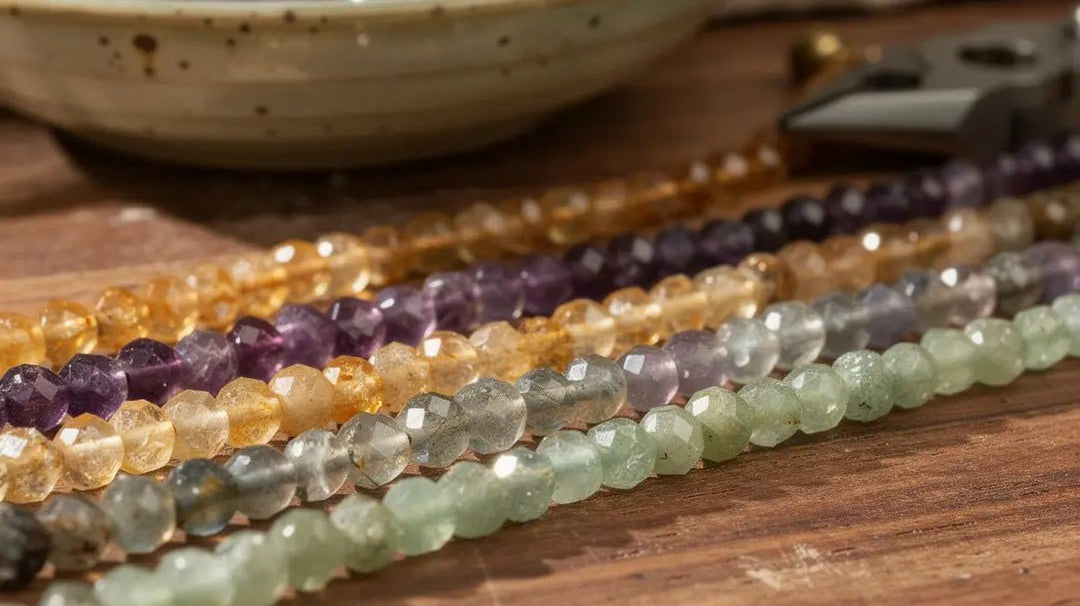
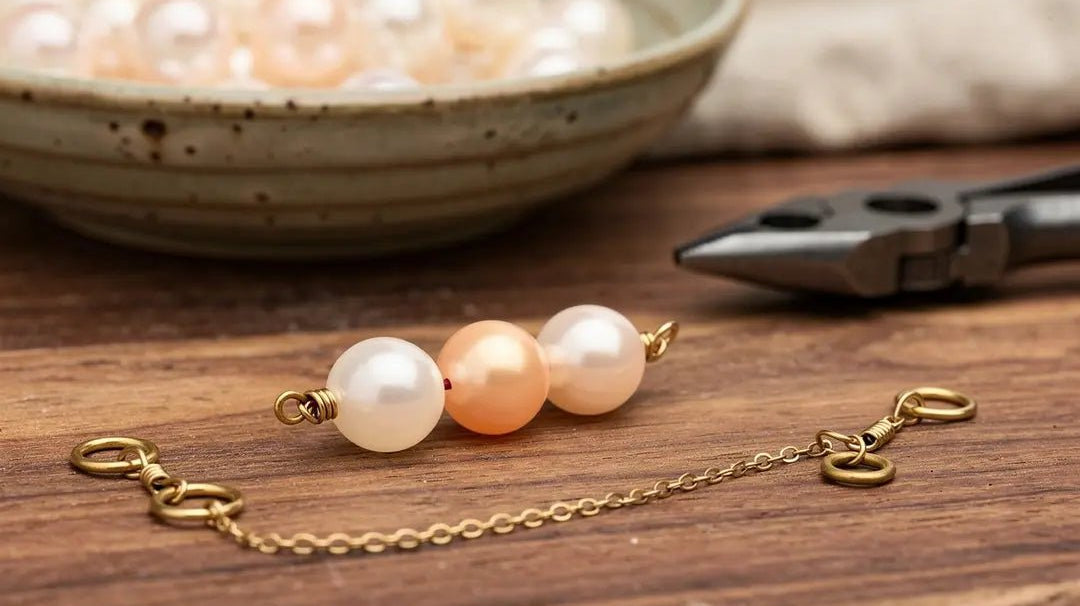
Working with chain-by-the-foot, rosary chain, and individual gemstone links gives you design flexibility that most jewelry techniques simply can't match. However, if you've ever stared at a tray full of gemstone beads and a spool of chain wondering how to put it all together, you're not alone.
It's important to bring these elements together in a way that looks intentional, not overworked. Even so, it's easier said than done. Each style brings its own structure, rhythm, and visual weight, impacting everything from delicate pieces to layered, statement-driven jewelry. That's why understanding how to keep everything cohesive is essential.
In this guide, we'll break down each chain style, how it's constructed, and how to use it intentionally in your designs. We'll also discuss unique elements of rosary chains, how to incorporate gemstone links, and where to find high-quality gemstone beads and chain materials.
With this, you can turn a pile of components into pieces that feel polished, balanced, and well-curated.
Understanding the Basics of Gemstone Bead Chain
A gemstone bead chain is one where the beads are the design, Rather than acting as accents, natural gemstone beads are directly integrated into the structure, either forming links themselves or set within a metal framework. The result is a chain that carries color, textural, and material interest on its own.
Nearly any gemstone can be cut and drilled for this purpose. However, this is where things become particularly interesting from a design perspective. Transparent materials, such as tourmaline, quartz, sapphire, and ruby, work beautifully in faceted formats. As we discussed in our post, "Micro-Faceted Gemstone Beads," this results in a piece that catches and light and adds movement from all angles.
Opaque and translucent styles, on the other hand, including lapis lazuli, turquoise, moonstone, and opal bring a softer, more dimensional depth. That range makes gemstone bead chains incredibly adaptable across different styles and aesthetics.
Compared to plain metal chains, a gemstone bead chain does a lot more visually. Rather than simply compliment other pieces, the chain itself becomes the focal point. This is precisely why it works so well in various designs, including bracelets, necklaces, and even drop earrings.
Varieties of Chain-by-the-Foot
Buying chain-by-the-foot gives you much more control over length. You cut exactly what you need for each project, effectively minimizing waste and allowing you to move between bracelets, necklaces, and earrings without committing to a fixed size. It's one of the most flexible ways to work with gemstone bead change.
However, understanding the unique factors that impact design success is essential. Below, we will discuss variations in type, scale and proportion, and ordering for consistency. With this, you can plan every detail prior to creating a piece.
Metal Finish and Overall Tone
Metal finish plays a major role in how a design reads. Gold plated, silver plated, rose gold plated, and black gold plated can each shift the look of the same gemstone. More importantly, in jewelry design, they act as insurance—reassuring the wearer that their chain won't snap or break.
A 4mm Lemon Quartz Gold Plated Chain, for example, has a warm, sunny quality. Comparatively, a 7x5mm Amazonite Double Nugget Silver Chain feels cooler and more minimal. Neither is universally better—it simply depends on your design intent.
Scale and Proportion
When pairing chain-by-the-foot with pendants or additional beads, proportion is key. A fine 2.5mm gemstone bead chain tends to read as subtle texture in the background, while a 5mm gemstone bead chain with larger faceted stones makes more of a statement.
If the chain is acting as the structural backbone of a piece, a slightly heavier scale adds presence. If it's meant to support a focal element, keeping the chain more delicate helps maintain balance.
Order for Consistency
If you're producing multiple pieces or need a seamless look, ordering multiple feet as one continuous length is worth it. Many chain-by-the-foot orders uncut when you purchase more than one foot, which preserves the natural rhythm and spacing of beads.
This small detail can make a noticeable difference, especially in designs where consistency and flow matter. At The Bead Traders, we put a lot of effort into ensuring all of our charms, connectors, metal clasps, findings, and toggles are as reliable as they are beautiful.
With the right supplier, you don't have to worry about quality—or consistency.
Designing with Rosary Chain
Rosary chain is defined by its construction: each bead is individually wire-wrapped, with a loop on either side that connects to the next bead. There are no strands of metal links in between, just a continuous series of wrapped stones. The result is a chain that feels dense, detailed, and more intricate than traditional link styles.
Below, we will explore important factors to consider when designing rosary chains:
Understanding the Look
The construction of a rosary chain creates distinct visual rhythm. Because every bead is connected directly to the next, rosary chains have continuous, fluid quality. It reads as more elevated and intentional, especially in designs where you want the material itself to stand out.
Multi-gemstone rosary chains, like our 3.5-4mm Multi-Gemstone Gold Hand Wrapped Rosary Chain, add another layer of interest. As the stones shift in color, the chain naturally moves between tones, giving it a dynamic, almost gradient effect. In contact, single-stone versions, such as our Tiger Eye Faceted Round Silver Wire Wrapped Rosary Chain, feel more grounded and uniform.
Choosing the Right Bead Size
Scale plays a significant role in how rosary chains function within a design. Smaller beads, like our 2.5-3mm Multi-Gem Silver Rosary Chain, create a fine, delicate look that works well for both layering or as a secondary element. This creates a complementary, cohesive look alongside more prominent pieces.
Larger beads, like our 5-5.5mm Multi-Gem Gold Rosary Chain, shift the piece into statement territory. At that size, the rosary chain can stand on its own without needing additional components, making it ideal for simple necklaces or bold bracelet designs.
Durability and Function
Beyond aesthetics, rosary chains are surprisingly durable. Each wire-wrapped connection acts as its own reinforcement point, which gives the chain added strength compared to many standard link styles.
Ultimately, that durability makes it well-suited for everyday wear. This is especially important for pieces that are meant to be handled often, like bracelets or long necklaces.
Incorporating Gemstone Links for a Unique Look
Individual gemstone links are a different format entirely. These are standalone stones set in a metal bezel with a ring on each side so they can be integrated directly into a chain. They're not chains themselves, but instead, structural or focal elements that you can build the design around.
What makes gemstone links interesting is the range of shapes and how those shapes affect the overall composition. Our 17mm Green Coin Drusy Vermeil Bezel Connector adds surface texture and a soft, centered presence. On the other hand, our 31x11mm Silver Bezel Grey Chalcedony Bar Connector introduces a more directional, geometric feel.
Ultimately, orientation matters just as much as the shape itself. East-west bars, for example, sit differently on the body and naturally guide the eye across the piece. Consider both comfort and style standards when choosing your gemstone link.
Additionally, when incorporating gemstone links into a chain, color balance becomes equally as important. Neutral stones blend seamlessly into most palettes, whereas more saturated or textured stones tend to draw attention. The surrounding chain should support the gemstone rather than compete with it.
You can browse the full range of bezeled gemstone pendants and connectors to get a sense of what's available in terms of shape, stone type, and size.
Essential Tools and Techniques
You don't need a lot of tools to work with gemstone chain. However, the right tools make everything cleaner, more precise, and a lot less frustrating. Below, we will discuss core tools to have, the foundation of wire wrapping, and how to manage transitions between chain styles:
Core Tools to Have on Hand
- Round-nose pliers for forming loops when attaching connectors or creating wire-wrapped links
- Chain-nose pliers for opening and closing jump rings, tucking wire ends, and working in into tight spaces
- Flush cutters for cutting chain and wire cleanly (a clean cut means less filing later)
- Jewelry file for smoothing any sharp wire ends before the piece is worn
- A ruler for measuring chain lengths accurately before cutting
Each tool plays a specific role, and having all within reach keeps your workflow and creative process efficient and consistent
Wire Wrapping: The Foundation Technique
Wire wrapping is at the core of working with rosary chain and custom links. The goal is consistency; creating uniform loop sizes and tight, secure wraps.
Loose or uneven wraps can shift over time, creating weak points that threaten the longevity of your piece. Therefore, taking the extra time to keep everything aligned makes a noticeable difference in both durability and overall finish.
Additionally, when attaching heavier elements, such as bezel-set gemstone links, a wrapped loop connection is always the better choice over a simple open loop. Ultimately, it adds structure and helps the piece hold up with regular wear.
Managing Transitions Between Chain Styles
One of the more overlooked details is how different chain styles connect. When a fine rosary chain meets a heavier metal link chain, the transition point needs to be intentional rather than abrupt.
A small jump ring or a neatly executed wrapped loop can bridge the gap cleanly. It's a subtle detail, but it's what separates a piece that feels cohesive from one that feels pieced together.
Combining Chain Styles for Versatile Designs
Using more than one chain style in a single piece is where designs can begin to feel more intentional. Mixing rosary chains, metal link chains, and gemstone connectors introduces contrast. This helps break up the visual weight, creating a natural rhythm throughout the piece.
For example, a short section of rosary chain between metal links adds detail without overwhelming the design. On the other hand, a single gemstone connector can instantly elevate a simple chain into something more considered.
Here's additional advice to consider when combining chain styles:
Layering with Intention
Layering works best when both length and chain type vary together. Think of it as building dimension:
- A fine 2.5mm rosary chain at 16 inches
- A medium metal link chain at 18 inches
- A longer chain with a gemstone connector at 20 inches
Each layer brings something different—texture, style, and focal point—so the overall look feels cohesive without being overly matchy. We discuss this concept further in our guide: "Garnet Beads for Jewelry Making: Practical How-To Guide."
Metal and Stone Contrast
Exploring metal contrast in your gemstone bead chain design can be a powerful tool. Gold-toned chains paired with cooler stones, like grey chalcedony or blue-toned turquoise, create a natural tension that makes both elements stand out.
Comparatively, silver-toned chains against warmer stones, like tiger's eye or lemon quartz, offer the same effect in reverse. It's less about matching perfectly and more about creating balance through contrast.
To preview this contrast, visit: "Which Gemstones Look Best with Metal Beads?"
Adding Accents for Structure and Softness
Incorporating small accents with a chain run can shift the entire feel of a piece. Freshwater pearls, for example, soften the look of a gemstone rosary chain and introduce a more organic element.
Metal spacer beads, on the other hand, add structure. Placed between gemstone links, they help maintain even spacing and create a more defined, intentional layout. This is especially important in designs where precision matters.
Where to Find High-Quality Gemstone Bead Chain Materials
The quality of your materials shows in the finished piece. Consistent bead sizing, clean wire wrapping, and reliable metal plating aren't small details. They're what separate a polished design from something that feels inconsistent or short-lived. That's why sourcing from a supplier that specializes in gemstone components makes a noticeable difference.
The Bead Traders is built around that level of consistency. Our selection of chain-by-the-foot includes hand-wrapped gemstone chains in gold, silver, and black gold plating, along with classic metal chains and freshwater pearl chains. This way, you can source multiple textures and finishes without switching between suppliers.
Our rosary chain offering covers single-stone options, like the 3mm Turquoise Howlite faceted rondelle Gold Wire Wrapped Chain, as well as multi-gem options in a range of bead sizes. The bezeled connector collection adds another layer of flexibility. With a wide range of shapes, stone types, and sizes, these links are designed to integrate seamlessly with their chain offerings. This makes it easy to build cohesive designs without second-guessing scale or compatibility.
For those producing at volume, our wholesale pricing structure is built directly into the shopping experience, with discounts based on cart total visible on product pages. And for U.S. orders over $100, free USPS First Class shipping makes it practical to stock up on chains, connectors, and loose beads in one streamlined order.
When your materials are consistent, your designs come together faster—and the final pieces reflect that.
Consider these tips your path to stunning, intentional jewelry designs.
Chain-by-the-foot, rosary chain, and gemstone links each bring something different to the table. Chain-by-the-foot gives you control over length and proportion. Rosary chain brings texture and detail that plain metal can't match. Gemstone links add focal points and color exactly where you want them.
Used together, these formats give you a lot of range. A well-chosen gemstone bead chain can carry a whole piece on its own, or it can be one element in a more layered design. Either way, the materials do a lot of the work for you. The natural color and texture of the stones, the rhythm of the wire wraps, the weight of a bezel-set connector—all these factors shape how the piece looks, moves, and feels when its worn.
Once you understand how each component behaves, the design process becomes less about adding more and more about choosing well.