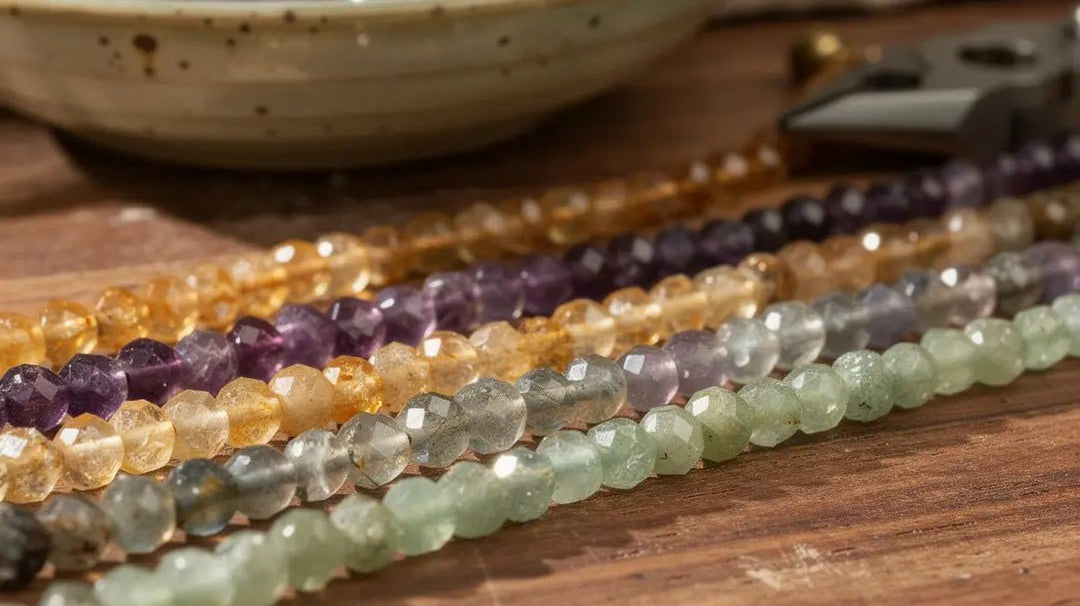
Many jewelry makers and bead enthusiasts often have one similar question: "How do I know if a gemstone bead is fake?" When shopping online, photos are polished, colors look vibrant, and the listing says natural. However, what arrives in the mail doesn't always match the description.
Dyed howlite is sold as turquoise, glass is passed off as quartz, gemstone beads are stabilized with no disclosure. Mislabeling and unclear product descriptions are common enough that buyers, especially jewelry makers sourcing online, need to know what to look for.
In this guide, we're discussing how to spot fake gemstone beads. We'll discuss different common terms, practical tests, and what to ask before making a purchase. At the end, you'll better understand how to avoid costly mistakes, protect the quality of your finished work, and shop with greater confidence.
How to Spot Fake Gemstone Beads: The At-Home Checklist
No single test tells the whole story. The goal is to evaluate multiple clues—appearance, feel, pricing, seller language, and return policies included. It's also worth clarifying upfront that gemstone treatments are not inherently a red flag. Heat treatment, dyeing, and stabilization are common practices across the industry. The real issue is misrepresentation.
This is why below, we're providing an at-home checklist when you're unsure how to spot fake gemstone beads. We'll cover the practical signs that can help you identify fake, misrepresented, or questionably labeled gemstone beads before they become part of a finished design
Know the Difference Between Fake, Synthetic, Treated, and Imitation
Gemstone technology can quickly become confusing, especially since sellers sometimes use overlapping language. Here's a quick breakdown of what each term means:
- Natural gemstones: Mined from the earth, then cut, shaped, drilled, and polished. These may still be treated unless otherwise disclosed.
- Synthetic or lab-created stones: Chemically similar or identical to their natural counterparts, but created in a lab rather than formed naturally.
- Imitation or fake stones: Materials like glass, plastic, ceramic, or resin designed to mimic the appearance of genuine gemstones without sharing the same composition.
- Dyed stones: Natural stones that have been color-enhanced with dye, often to imitate more valuable materials or create brighter, less natural hues.
- Stabilized stones: Porous gemstones, such as turquoise, that have been reinforced with resin or polymer to improve durability.
- Composite or assembled stones: Beads made from multiple materials bonded together, either for practical manufacturing purposes or, in some cases, misleading presentation.
Broad phrases like "genuine gemstone" or "real stone" are not informative on their own. Specific terms, such as natural, untreated, heat-treated, dyed, stabilized, synthetic, or imitation give you a much clearer picture of what you're actually buying.
If you want a deeper breakdown, visit our guide: "Natural vs. Treated Gemstone Beads." In this, we explore why disclosure matters more than treatment alone.
Start With the Seller's Description
Before touching a single bead, read the listing carefully. A trustworthy product description should clearly identify the stone, along with details like bead size, strand length, shape, finish, and any disclosed treatments.
Be cautious of vague phrases, like "natural style," "gemstone look," or "mixed stone." Aside from being confusing, this can signal unclear or intentionally broad labeling. Additionally, avoid listings that rely on a color name alone. If a seller cannot clearly differentiate the stone, it's worth taking seriously.
Next, make sure to read "How to Buy Wholesale Gemstone Beads Online with Confidence." In this guide, we discuss the importance of credible seller policies, average wholesale pricing, and the level of transparency you deserve as a buyer.
Visual Tests: What Your Eyes Can Catch First
Good lighting is your first visual tool. Natural daylight or a bright, neutral light source makes it easier to spot the details that matter.
Natural gemstone beads typically show some level of variation, whether its inclusions, subtle color shifts, organic veining, or irregular patterning. That character is often what makes them appealing. However, if every strand looks perfectly identical in color, pattern, and surface appearance, it's worth questioning.
As our stone bead testing guide puts it: no two natural beads are exactly the same, so perfect uniformity signals synthetic origin.
Check Color Consistency Without Expecting Perfection
Natural gemstone beads usually show some variation from bead to bead, and that's entirely normal. What deserves a closer look is a strand where every bead displays the same exact intensely saturated, flat color with little to no variation.
Other potential red flags include color pooling around drill holes, unusually uniform color throughout the entire strand, or dye transferring onto a white cloth. Dyes degrade; natural color is part of the mineral structure and won't fade the same way.
Learn more about how this process works through reading our post, "Natural vs. Dyed Coral Beads: How to Spot the Difference."
Look Closely at Drill Holes
Drill holes are often one of the most revealing places to inspect a bead. Dye can collect around rough edges, making it easier to spot concentrated color, a lighter or different colored core, visible coating layers, or unusually glassy interiors.
Natural gemstone beads may show small chips, uneven edges, or subtle fracture patterns around the drill hole. However, imitation or synthetic materials often appear smoother and more uniform.
Use a Loupe or Phone Magnifier
A 10x jeweler's loupe is ideal for identifying fake gemstones, but a phone camera’s zoom or magnifier setting can still be useful for a quick inspection. Under magnification, look for air bubbles (a common sign of glass), mold lines, paint-like surface coatings, glue seams, or identical repeating patterns across multiple beads.
Details like this are often difficult to spot with the naked eye but become much more obvious when magnified.
The Touch and Temperature Test
Touch can offer useful clues, though it should never be treated as a distinctive test on its own. Natural gemstone beads typically feel cool at first contact, taking a little time to warm up in the hand. Glass can behave similarly, which is why this test is more helpful for ruling out obvious imitations than confirming authenticity.
Plastic or resin beads, on the other hand, often feel warmer, lighter, and less substantial almost immediately. To test this, press the bead against the inside of your wrist rather than your palm, since that area tends to be more temperature-sensitive. A genuine mineral holds that coolness noticeably longer than plastic or resin does.
Compare Similar-Sized Beads
When you're trying to analyze a fake gemstone bead, side-by-side comparisons help the most. This is especially true if you already own a strand from a trusted source. Comparing beads of a similar size can reveal differences in weight, finish, color variation, and overall feel that may not be obvious on their own.
Additionally, because gemstone density varies by mineral, this works best when you're comparing the same gemstone type rather than entirely different materials. Unusual lightness in a "stone" bead, especially paired with a low price, deserves more scrutiny.
The Weight Test: Heft Can Reveal Imitations
Weight can offer another useful clue when evaluating gemstone beads. Natural minerals have measurable density, often a fixed mass-to-volume ratio. In other words, genuine stone beads will feel noticeably more substantial than plastic or resin imitations of the same size.
A small jewelry scale can help if you want to get more precise, but even holding the strand in your hand gives you a rough sense of whether the weight matches what you'd expect from stone.
When Weight Is Most Helpful
Weight comparison is most useful when you're evaluating similar bead sizes, strand lengths, and the same gemstone type. A strand of quartz should not be compared to hematite, for example, as mineral density varies.
If a "stone" bead feels unusually light for what they claim to be, especially alongside a suspiciously low price, it's worth investigating further. Weight alone won't confirm authenticity, but it's a useful filter when something feels off.
The Streak Test: Useful, But Use With Caution
The streak test involves rubbing a mineral against unglazed porcelain to observe the color of the powder it leaves behind. While this is a legitimate mineral identification method, it's generally not the best choice for finished gemstone beads.
Ultimately, the test can scratch or damage the bead's surface. Because of this, it's better suited for minerals softer than the porcelain plate (roughly hardness 6.5 or below). Harder stones, such as quartz or topaz, are more likely to scratch the plate than produce a meaningful streak.
Why Streak Testing Is Not Always Ideal for Finished Beads
Polished, drilled gemstone beads are finished jewelry materials, not rough mineral specimens. Because of this, a streak test can easily damage something you actually plan to use. Surface treatments can also make the results unreliable, since dye and coatings may streak instead of the underlying mineral.
If you decide to try this method, it’s safest to use a spare bead or test an area that won’t be visible in the finished design.
Safer Alternatives Before Trying a Streak Test
There are other methods worth trying before attempting the streak test. For example, gently rub the bead with a white damp cloth and look for any color transfer, which can suggest surface dye. You can also apply a small drop of acetone to an inconspicuous area, since some dyed or coated materials may show color bleeding or surface reaction.
These methods are not foolproof, but they’re often more practical (and far less damaging) than a streak test when evaluating finished gemstone beads.
The UV Light Test: What Fluorescence Can and Cannot Tell You
Some gemstones, dyes, resins, and fillers fluoresce under UV light, which can make this a useful observational test. However, it's not a definitive one. A strong or unusual glow, for example, may offer clues about treatment, fillers, or imitation materials. But fluorescence alone cannot confirm authenticity.
Some genuine gemstones naturally fluoresce, while some imitations show little to no reaction at all. For example, certain imitation materials commonly used in place of turquoise may react differently under UV than natural turquoise, and genuine Baltic amber is known for its characteristic fluorescence. The key is to treat UV response as one data point among several, not a final verdict.
How to Perform a Basic UV Check at Home
Use a small UV flashlight in a dim room. Never look directly at the light, though, as shortwave UV can damage your eyes. Compare multiple beads on the strand and look for uneven fluorescence, glowing filler in cracks, or suspiciously bright coatings. If one bead on a strand glows dramatically differently from the others, that's worth investigating further.
Price, Perfection, and Pattern Red Flags
Pricing can be a useful reality check. Rare or premium gemstone materials typically come with corresponding costs, so unusually low prices deserve a closer look.
For example, heavily discounted “turquoise” is often actually dyed howlite, magnesite, or another imitation material, especially when paired with overly uniform color or patterning. Other red flags include identical markings across every bead, flawless saturation throughout an entire strand, or listings that claim rare gemstones at bargain pricing.
Price alone will not confirm authenticity, but when a deal feels unusually generous for the material being advertised, it’s worth asking more questions.
Common Bead-Specific Warning Signs
- Discoloration or concentrated dye around drill holes
- Chipped coatings that reveal a different color underneath
- Beads that feel plasticky or unusually light
- Identical swirls or banding patterns repeated across every bead
- Color bleeding onto your fingers or stringing material
- Unusually glossy surfaces with no natural texture
- Strand labels that don't match the seller's description
What a Good Inspection Policy Should Include
When vetting a supplier, look for clear product naming, treatment disclosures, consistent sizing information, realistic photos, and a quality control process.
At The Bead Traders, treatments are disclosed directly in product descriptions across our Gemstone Bead Collection—you don't have to hunt for it. Additionally, our 3 Promise Value Pledge includes a No Substitution, No Downgrade Policy and an Any Piece Quality Inspection, so what you see in the listing is what arrives.
Why Return Policies Matter
Even careful shoppers sometimes need to inspect beads in hand before committing to a design. A fair return policy reduces the risk of testing a new supplier. The Bead Traders accepts returns and exchanges within 30 days, and U.S. orders over $100 qualify for free shipping and returns. That makes it easier to evaluate a strand without feeling locked in.
When to Seek Professional Gem Testing
At-home tests cover a lot of ground, but they have limits. For high-value purchases, professional gemological testing is worth considering. Labs and trained gemologists use refractometers, spectroscopes, thermal probes, and microscopes to identify stones and detect treatments that home tests can't catch. Additionally, GIA offers colored stone identification services if you need a formal assessment.
Consider professional testing for high-value strands, rare gemstone claims, antique or inherited beads, resale inventory, or anything purchased from an unknown supplier. For everyday jewelry-making materials from a reputable source, a solid home inspection combined with clear supplier disclosures is generally a solid approach.
When you know how to spot fake gemstone beads, you can become more confident in your purchases.
Knowing how to spot fake gemstone beads isn't about being suspicious of everything; it's about having the tools to make informed decisions. Combine visual inspection, temperature and weight checks, cautious dye testing, UV observation, and price evaluation. Then pair all of that with a close read of the seller's product language and policies.
When you buy from a supplier who labels treatments clearly, maintains consistent grading, and backs their products with a fair return policy, you spend less time second-guessing and more time making. Browse our gemstone beads, freshwater pearls, metal beads and findings, chain by the foot, and new arrivals—all with treatment details upfront. With this, you can design with intention and stand behind every piece you make.