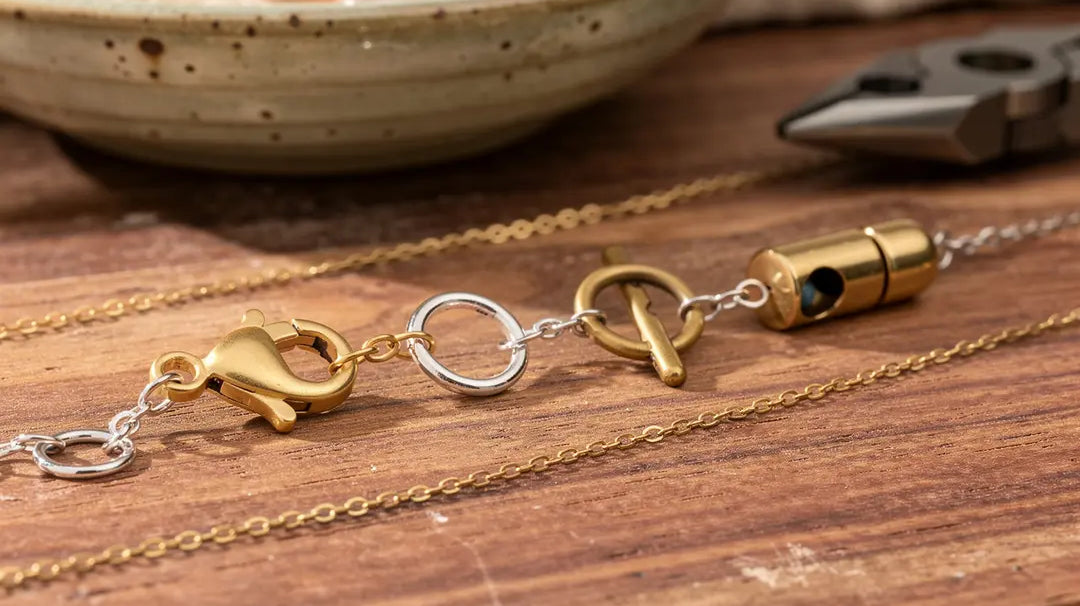
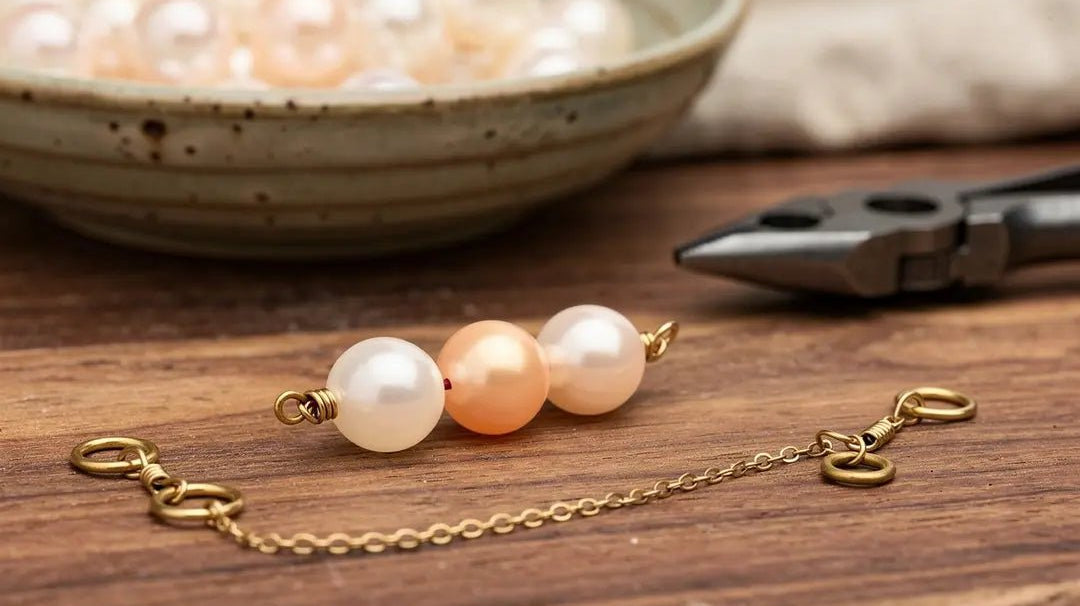
A necklace clasp might be a small detail, but it has a pretty important job. It needs to keep your necklace secure, feel comfortable to wear, and work with the overall look of your design. And with so many different clasps to choose from, the right option isn't always obvious.
Some clasps are better suited to lightweight beaded strands, while others can handle heavier gemstones or layered designs. You'll also want to think about how easy the clasp is to open and close, whether you want it to blend into the design or become a part of it, and how it will attach to your stringing material.
In this guide, we'll walk through some of the most common types of necklace clasps, their pros and cons, and how to attach them so you can choose the right finishing touch for your next jewelry project.
Quick Answer: Which Clasp for Which Necklace?
Need a starting point? Here's a quick look at which necklace clasps tend to work well for different types of designs:
- Everyday Chain or Pendant Necklace: A lobster claw clasp is a reliable choice. It's secure, durable, and easy to use for most everyday pieces.
- Delicate, Lightweight Chain: Try a spring ring or small barrel clasp that complements the scale of the chain without overpowering it.
- Heavy Gemstone or Statement Strand: Look for a larger lobster claw, a sturdy toggle clasp, or a box clasp with an added safety feature to support the weight of the piece.
- Pearl Strand: Filigree box clasps and fishhook clasps are classic choices that complement the traditional look of pearls.
- Multi-Strand Design: A slide or tube clasp can keep multiple strands organized, while a multi-ring magnetic clasp offers another easy-to-use option.
- For easier fastening: Magnetic clasps can work well for lighter necklaces, while oversized lobster clasps and toggle clasps provide a larger closure that may be easier to handle.
The Main Types of Necklace Clasps, Compared
Lobster Claw Clasp
A lobster claw clasp uses a small spring-loaded lever to open and close, creating a secure connection that works for all kinds of everyday jewelry. It's one of the most popular necklace clasps for good reason: lobster clasps are durable, relatively easy to fasten, and available in enough sizes to work well with everything from delicate chains to heavier beaded strands.
Size your clasp to the rest of the necklace. Smaller lobster clasps work well with fine chains, while larger options feel more balanced and secure on chunky gemstone or statement pieces.
The Bead Traders Lobster Clasp Collection includes sizes from 10mm to 23mm in finishes like gold, silver, rose gold, black, and copper, making it easy to coordinate the clasp with the rest of your findings.
Best For: Chains, pendants, and most single-strand bead necklaces.
Watch Out For: Choosing a clasp that's too small for the weight of your necklace or attaching it with a weak jump ring.
Spring Ring Clasp
A spring ring clasp is a small, circular closure with a tiny tab that opens the ring. Its slim profile makes it a good match for delicate jewelry where a larger clasp might feel bulky or distract from the design.
Spring rings work best with fine chains, lightweight pendants, and other pieces that don't put much strain on the closure. It can be trickier to open lobster clasps, though, especially because of the small tab.
Best For: Fine chains, lightweight pendants, and minimalist necklaces.
Watch Out For: Using one on a heavy necklace or choosing a clasp that's too fine to fasten comfortably.
Toggle Clasp
A toggle clasp has two parts: a bar and a ring. To close it, the bar passes through the ring and turns sideways to hold the necklace in place. Because the clasp relies on the bar staying across the opening, it's important to choose a toggle that's properly sized for the necklace.
The Bead Traders Toggles and Clasps Collection includes classic and decorative designs that pair beautifully with gemstone beads, giving you plenty of ways to make the closure feel intentional rather than purely functional.
Best For: Heavier beaded necklaces, statement pieces, and front-closing designs.
Watch Out For: A bar that's too short for the ring or using a toggle on an extremely lightweight necklace that doesn't provide enough tension to keep it in place.
Magnetic Clasp
Magnetic clasps use two magnetic ends that snap together when they're brought close, making them one of the easiest necklace closures to fasten. They're especially useful when you want a clasp you can open and close with one hand, without having to work a tiny lever.
The trade-off is security. Magnetic clasps are generally better suited to lightweight and moderately weighted necklaces than heavy gemstone strands, since enough pulling or snagging can separate the two halves. For heavier designs, consider adding a safety chain or choosing a mechanical clasp instead.
The Bead Traders' Magnetic Clasp Collection includes simple and decorative options, along with multi-strand magnetic clasps for designs that need more than one attachment.
Best For: Lightweight to moderately weighted necklaces, easy-to-fasten designs, and some multi-strand pieces.
Watch Out For: Heavy necklaces or designs that may be easily snagged.
Safety Note: Magnetic jewelry may interfere with pacemakers and implantable cardioverter-defibrillators (ICDs). The American Heart Association recommends keeping magnets at least six inches away from an implanted device. If you sell finished jewelry with a magnetic clasp, make sure the wearer knows that the closure contains a magnet.
Box Clasp
A box clasp uses a small tab that slides into a decorative housing and locks into place. Many styles also include a safety catch for extra security, making them a popular choice for pearl and gemstone necklaces.
Unlike clasps that are meant to blend into the chain, box clasps can become part of the design itself. Filigree and other decorative styles pair especially well with the classic pearl strands or higher-end beaded pieces where you want the closure to feel just as polished as the rest of the necklace.
Best For: Pearl strands, gemstone necklaces, and designs that call for a decorative but secure closure.
Watch Out For: Very small box clasps that can be difficult to fasten and worn or loose locking mechanisms.
Hook-and-Eye and S-Hook Clasps
Hook-and-eye and S-hook clasps are some of the simplest necklace closures. A curved hook slips through a loop to secure the necklace, with no springs or moving parts involved. They're easy to use, easy to repair, and can add a handcrafted look to the finished piece.
Because the shape of the hook is what keeps the necklace closed, make sure it's sturdy and properly formed. A hook that's too open can slip out of the loop, especially if the necklace gets tugged or caught on something.
You can find S-hooks, hook-and-eye closures, and other decorative options in The Bead Traders' Toggles and Clasps Collection.
Best For: Artisan-style necklaces, beaded designs, and front-closing pieces.
Watch Out For: Hooks that are too open, thin, or easily bent out of shape.
Fishhook Clasp
The fishhook clasp is a traditional choice for pearl necklaces. It uses a small hook-shaped piece that slides into the other half of the clasp and locks into place, creating a secure closure with a discreet, polished look.
These clasps work especially well when you don't want the closure to compete with the pearls or beads themselves. The trade-off is that their small size can make them a little more difficult to fasten behind the neck.
Best For: Pearl strands and other classic, delicate necklace designs.
Watch Out For: Small clasps that may be difficult to fasten without help.
Barrel Clasp
A barrel clasp has two ends that screw together to form a smooth, cylindrical closure. Its streamlined shape makes it a good option when you want the clasp to blend into the necklace rather than become part of the design.
Because both ends need to be twisted together, barrel clasps usually require two hands and can be harder to fasten behind the neck. They also need to be screwed together completely to stay secure.
Best For: Delicate chains, lightweight beaded necklaces, and designs where you want a subtle closure.
Watch Out For: Loose connections and designs intended for someone who may have difficulty gripping or twisting a small clasp.
Slide and Tube Clasps for Multi-Strand Necklaces
Slide or tube clasps are designed specifically for multi-strand necklaces. Instead of attaching several strands to a single ring, these clasps provide multiple attachment points that help keep each strand separated, organized, and lying neatly.
Traditional versions slide together to lock in place, while magnetic slide clasps use magnets for easier fastening. When choosing one, look for a clasp with the same number of attachment points as your necklace has strands.
The Bead Traders carries options like a 3-Strand Magnetic Slider Clasp and 5-Ring Magnetic Slide Clasp, making it easier to finish layered and multi-strand designs without crowding every strand onto one connection point.
Best For: Multi-strand necklaces and layered beaded designs.
Watch Out For: Choosing the wrong number of attachment points or using a magnetic version on a necklace that's too heavy for it.
Fold-Over and Bayonet Clasps
Fold-over and bayonet clasps are less common, but they can be useful when you want a secure closure with a low-profile finish. A fold-over clasp uses a hinged piece that folds over a catch and snaps into place. You'll often see this style on chains and other designs where a flat closure works well.
A bayonet clasp uses two pieces that push together and twist to lock, creating a compact closure that can blend neatly into the rest of the necklace.
Best For: Streamlined necklaces and designs where you want the clasp to stay relatively unobtrusive.
Watch Out For: Worn locking mechanisms or choosing a clasp that's too small to operate comfortably.
Matching the Clasp to Weight and Style
Once you've narrowed down the type of clasp you want to use, make sure its size and strength match the rest of the necklace. A delicate chain and a chunky gemstone strand, for example, put very different demands on a closure, so the same clasp won't necessarily work for both.
As the weight and size of your beads increase, your clasp and connecting components should generally scale up with them. As an example, our hematite design guide recommends sturdy lobster clasps and soldered jump rings for dense gemstone designs, along with stringing wire and crimps suited to the weight of the piece.
Think about appearance, too. Your clasp should feel proportional to the beads or chain and coordinate with the other metal components in your design. Matching your clasp to a gold-plated chain, jump rings, spacers, and other findings creates a much more intentional finished look.
Clasp Metals and Finishes: What the Labels Actually Mean
Because necklace clasps are handled every time the piece is worn, their finish can show wear sooner than less frequently touched components. Knowing a few common jewelry terms can help you choose findings that fit your project and accurately describe the finished piece.
- Sterling Silver: Contains at least 92.5% silver. A silver-plated clasp has a thin layer of silver over another metal and is not the same as solid sterling silver.
- Gold Filled: Uses a thicker, mechanically bonded layer of gold alloy over a base metal, making it more durable than standard gold plating.
- Gold Plated: Has a layer of gold applied over a base metal such as brass or copper. It gives you the look of gold at a more accessible price point, but the plating can wear over time.
- Vermeil: Uses sterling silver as the base metal with a layer of gold over it. Gold-plated brass or copper is not considered vermeil.
The Bead Traders carries jewelry findings in a variety of plated finishes, making it easy to coordinate your clasp with the beads, chain, and other components in your design. Whichever material you choose, use the same level of quality throughout the closure whenever possible so everything wears consistently.
How to Attach a Necklace Clasp So It Lasts
Even the right clasp won't hold up if the connection to the necklace is weak. The exact method depends on what you're stringing with, but for beading wire, you'll typically need a clasp, crimps, crimping pliers, and any jump rings or other connectors your design requires.
To attach the clasp, thread a crimp onto the beading wire, pass the wire through the clasp or connecting jump ring, and bring the end back through the crimp. Use crimping pliers to secure it, then repeat on the opposite end of the necklace. Our gemstone jewelry DIY guide walks through the basic process in more detail.
A few finishing details can make the connection stronger and give your necklace a more polished look:
- Use components suited to the necklace's weight. Heavy gemstone strands may need sturdier crimps, jump rings, and clasps than lightweight designs. For substantial pieces, soldered or closed rings can provide a stronger clasp connection than an open jump ring.
- Protect the beading wire. A wire guardian can protect the loop of wire where it connects to the clasp, one of the areas that experiences the most friction.
- Finish your crimps. Crimp covers hide the crimp tube and create a cleaner, more finished appearance.
- Choose the right finish for multi-strand designs. A slide clasp gives individual strands their own attachment points, while bead cones can gather multiple strands into a single connection
- Consider adding an extender chain. An extender gives the wearer some flexibility with necklace length and provides a larger area to work with when fastening the piece.
For chain necklaces, you generally won't need crimps. Instead, connect the clasp to the end of the chain with an appropriately sized jump ring and add a ring or extender to the opposite side. Pearl and corded designs may require different finishing techniques depending on the stringing material and style of the necklace.
Choosing a Clasp That's Easier to Fasten
Ease of use matters just as much as appearance, especially when you're designing for someone who finds small clasps difficult to grip or operate.
Magnetic clasps are among the easiest options to fasten, particularly on lightweight necklaces. Toggles are another good choice because they don't require working a tiny lever, while an oversized lobster clasp provides a larger surface to grip. You can also add an extender chain to make the closure easier to find and handle.
For some designs, you may be able to skip the clasp entirely. A long continuous necklace that comfortably slips over the head eliminates the need to fasten a closure at all.
If you sell finished jewelry, offering a choice of clasp styles can also give customers the option to choose the closure that feels most comfortable for them.
Frequently Asked Questions About Necklace Clasps
What is the most secure type of necklace clasp?
Lobster claw and box clasps both provide a secure closure when properly sized and attached. For heavier necklaces, the strength of the jump rings and other connecting components matters as much as the clasp itself.
What size lobster clasp should I use for a necklace?
Choose a lobster clasp that feels proportional to the chain or beads and can comfortably support the necklace. Smaller clasps work well for delicate chains, while larger clasps generally fit better for heavier gemstone and statement necklaces.
Are magnetic clasps strong enough for heavy necklaces?
Magnetic clasps are generally better suited to lightweight or moderately weighted necklaces. For a heavy gemstone strand or valuable piece, consider a more secure mechanical clasp or add a safety chain.
Which clasp is best for a pearl necklace?
Fishhook and decorative box clasps are traditional choices for pearl necklaces. A small lobster clasp can also work if you prefer a simpler, more contemporary finish.
What is the easiest necklace clasp to put on by yourself?
Magnetic clasps are among the easiest to fasten because the two ends connect without a small lever. Toggle clasps and larger lobster claws can also be easier to handle than tiny spring rings or barrel clasps.
Can I use a "sterling silver plated" clasp on a sterling silver necklace?
Yes, but a silver-plated clasp is not the same as solid sterling silver. If you’re selling the finished necklace, describe its materials accurately rather than representing the entire piece as sterling silver.
Finish Your Necklace With the Right Clasp
The right clasp should feel like part of the necklace, not an afterthought. Think about the weight of your beads, how the necklace will be worn, and whether you want the closure to blend in or add another decorative detail to the design. Just as importantly, pair it with sturdy jump rings, crimps, and other findings that can support the finished piece.
At The Bead Traders, you can find lobster clasps, magnetic clasps, toggles and clasps, and other jewelry-making findings to put the finishing touches on your next necklace. Pair your clasp with our gemstone beads, chain, and other components to create a piece that looks polished from end to end. U.S. orders over $100 get free shipping and free returns.